
Every IT and security team is expected to answer a deceptively simple question: who has access to what, why, and for how long?
In practice, answering that question is anything but simple. A typical identity and access management (IAM) governance framework spans multiple identity providers, dozens of SaaS applications, ticketing systems for access requests, and internal policies defining who should have access versus who actually does. Access grants pile up over time — a contractor who never had their permissions revoked, a former team member's SaaS license that's still active, a temporary elevated-access ticket that was never closed out.
This is the core challenge of IAM governance: access requests threaten to outpace IT’s ability to review them.
Today, most organizations manage this through manual processes:
Periodic (often quarterly or annual) access reviews conducted via spreadsheets or exports from an identity provider
Manually cross-referencing access requests in a ticketing tool against what's actually provisioned in each connected app
Chasing down approvers to confirm that access grants are still needed
Reactively discovering policy violations during an audit, rather than catching them in real time
This is slow, error-prone, and creates real compliance risk. A governance framework that only gets exercised once a quarter means violations - over-permissioned accounts, expired access that was never revoked, requests that bypassed approval - can sit unresolved for months. For regulated industries, that's not just an operational inefficiency; it's an audit finding waiting to happen.
A better approach treats identity governance as a continuous, automated process rather than a periodic manual exercise: a system that ingests data from every connected identity and access source, maps it against governance policy in real time, and surfaces violations and expirations before they become compliance problems — with humans still firmly in control of any actual access changes.
That's exactly what we set out to build using Tines 3B.
The hands-on solution: Building an identity governance dashboard with Tines 3B
With Tines 3B, you can build a private web dashboard with both UI controls and HTTP API routes, so actions can be triggered by a person or by another system. Scheduled jobs handle identity synchronization and access expiry checks, but—by design—those schedules stay disabled until integrations and policies have been validated. This keeps a human in the loop before anything runs unattended in production.
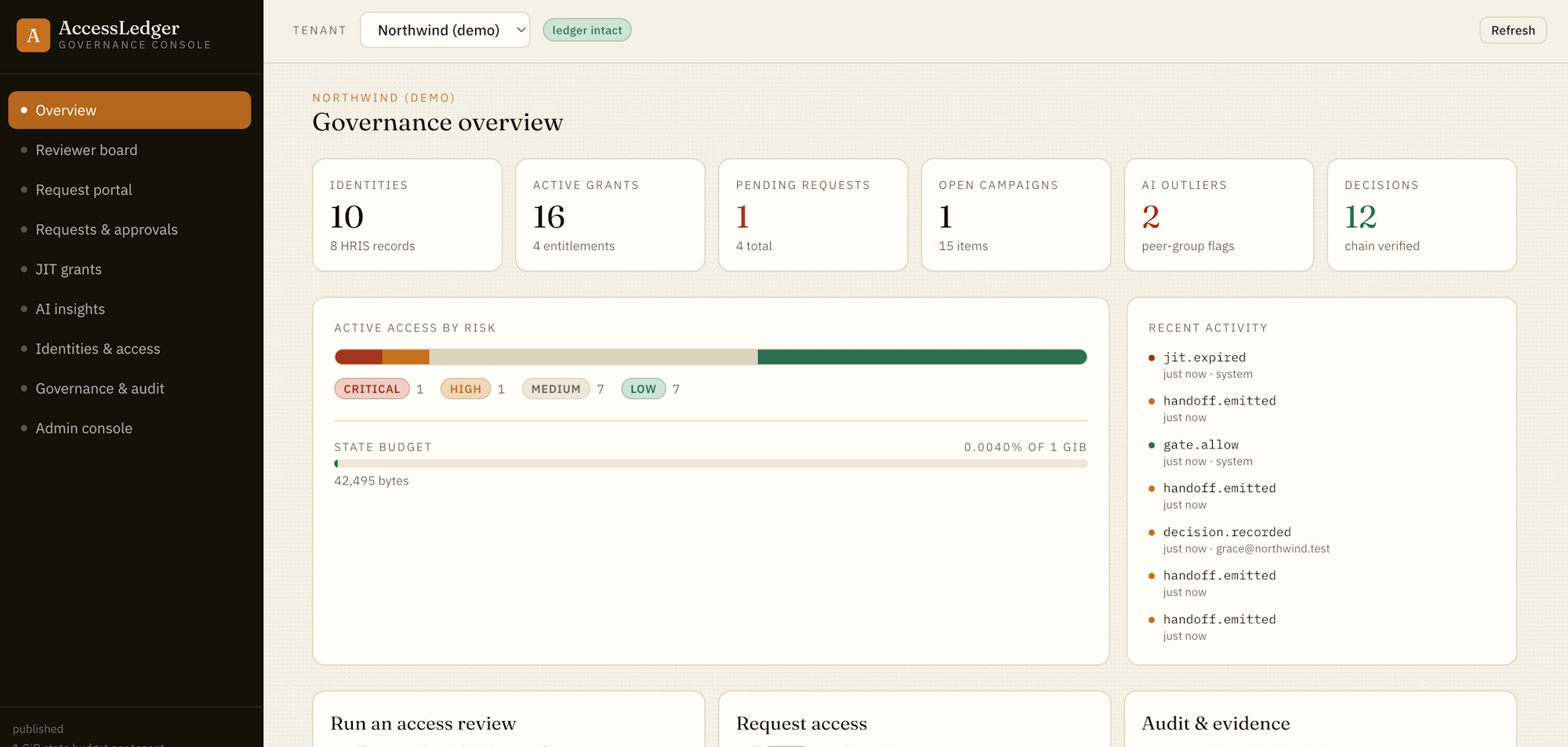
From there, the day-to-day flow looks like:
Identities and entitlements sync into a searchable inventory
Reviewers get assigned to recurring access-review campaigns
Reviewers certify or revoke access, with every decision recorded
Employees submit self-service access requests, which route through approval workflows
Approved grants can be time-limited, with automatic expiry handling
What it connects
This workflow is designed to integrate with identity providers like Okta, productivity suites like Google Workspace, and SCIM-compatible HR information systems (HRIS)—the categories most organizations rely on for identity and access management. The same pattern extends to other IdPs, directory services, and ticketing platforms depending on your stack.
This particular example uses
Okta for identity and authentication data
Google Workspace for application-level entitlements
A SCIM-compatible HRIS for employment status and role data
SQLite as the underlying data store for the inventory and decision history
HTTP API routes for programmatic access and integration with other internal tools
From manual audits to governed, automated access reviews
The workflow eliminates the manual work at the center of most IAM governance programs: pulling identity and entitlement data from multiple systems into one inventory instead of exporting spreadsheets, launching and assigning recurring access-review campaigns on a schedule, flagging access that's approaching expiry or falling out of policy alignment, and capturing review decisions automatically rather than relying on email threads or ticket comments.
Control stays with the team throughout-integrations and policies must be explicitly validated before scheduled sync and expiry jobs are enabled, changes to access in external systems require explicit approval before they take effect, reviewer permissions and approval policies are configurable so the right people make certification decisions, and a tamper-evident decision history provides an audit trail with export capability for compliance evidence.
The result is a single dashboard with real-time oversight of access requests, active permissions, and policy alignment across every connected system, in place of manually checking multiple consoles. Governance violations and approaching expirations surface automatically, so teams can act before they become compliance findings, saving the hours typically spent on manual quarterly audits.
Why use Tines 3B?
What makes building an IAM governance framework like this in Tines 3B different from a one-off scripted integration is what happens after the initial build:
Speed from prompt to working solution: the entire architecture — connectors, sync logic, review engine, multi-tenant isolation — was scaffolded from a single detailed prompt, not built integration-by-integration from scratch.
Autotune: as you connect more systems or your governance policies evolve, the workflow can be refined without a full rebuild.
Autofix: if a connector breaks or an API changes, Tines 3B can help identify and resolve the issue rather than leaving you to debug it manually.
Ongoing maintenance and monitoring: governance isn't a one-time project, it needs to keep working as your identity stack changes. Tines 3B gives you visibility into whether the workflow is still running as expected.
Adaptability: add a new identity provider, a new SaaS app, or a new policy rule, and the workflow can evolve rather than requiring a parallel one-off build.
Once this is in place, it's a natural jumping-off point for related workflows; automating new-hire onboarding; building out IT ticket triage and routing, or extending governance checks into endpoint compliance.
If you're responsible for identity and access management governance at your organization, this is a good place to start. You can explore the example, copy the prompt, and adapt it to your own identity stack for free using the Tines 3B Explore Edition.