

In July, we launched Tines 3B to the world, and it’s been incredible to see the response from our customers. It wasn’t a surprise though, we had a sneak peek of how much value 3B could bring when we launched it internally.
On June 2, around eight weeks before the product's general availability, we unlocked the doors of 3B, let every single Tines employee into our own instance, and invited them to start building.
What we witnessed was building, experimentation, and iteration on a scale we never saw before. In days, people had transformed parts of their roles that carried the most friction and repetition — finance shipped a billing app, recruitment launched a candidate pipeline dashboard for hiring managers, and legal built a new business-wide query management process.
We already had a strong culture of using our product, Tines Stories, to solve our problems. But there was still plenty of untapped potential across the company for teams to start building fast with AI.
With Tines 3B, there’s no barrier to entry. You can go from signing in to the platform for the first time, to a comprehensive V1 of your build in minutes. That speed set off a wave of excitement, and, soon, people who'd never built a piece of software before were proudly sharing their apps and automations in company-wide Slack channels.
The data from this experiment tells a really exciting story. It took our employees over 7 years to reach the milestone of 1,000 live workflows built with Tines Stories. With Tines 3B, our teams hit that same milestone in just 90 days.
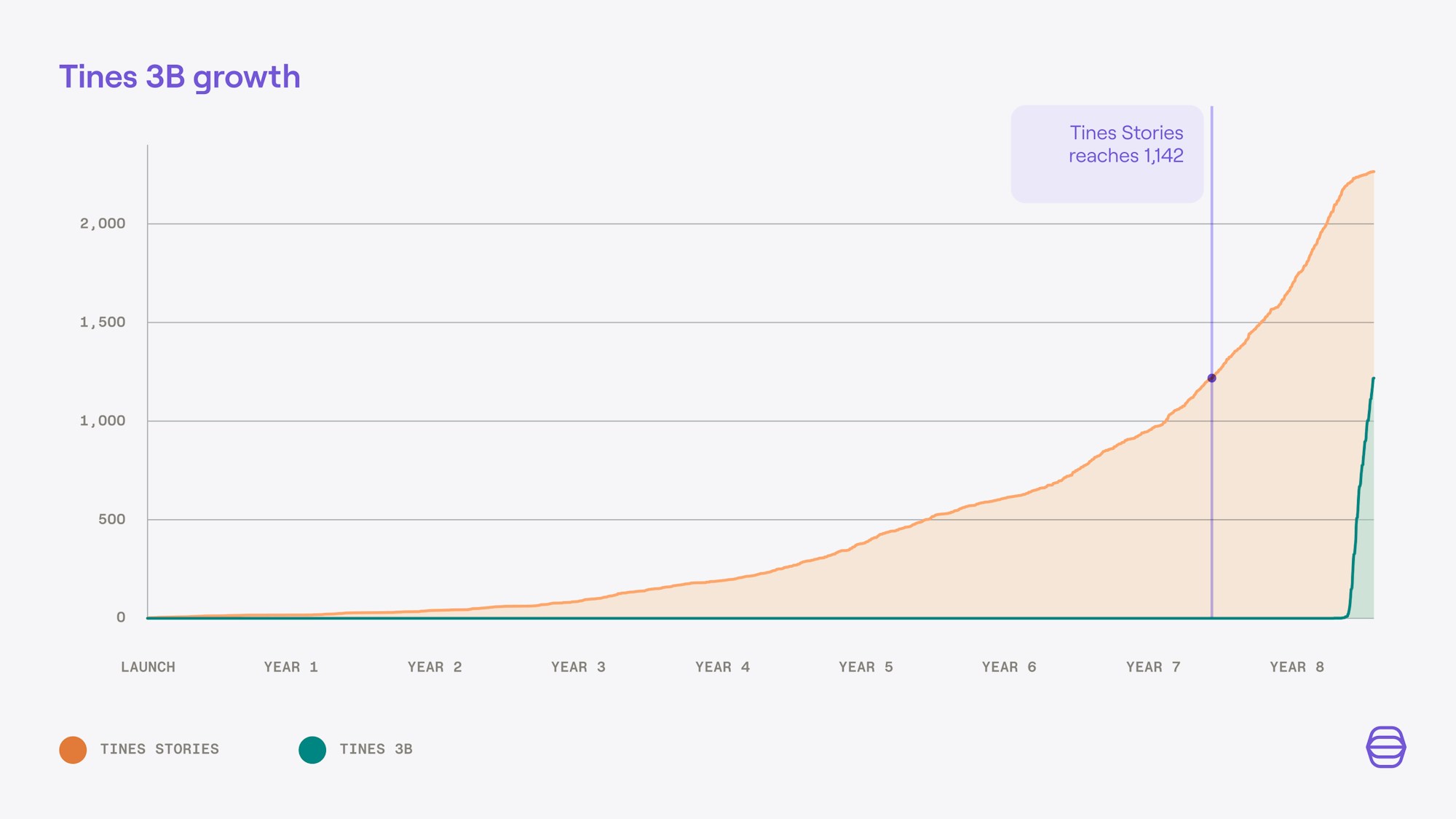
Tines Stories was already the fastest workflow platform on the market — one customer told us building in Tines Stories was 175x faster than the next-gen platform they’d previously used. We don't have that kind of customer data for Tines 3B yet, but based on what we've seen internally, and early wins shared by customers like Headspace, the speed of adoption with Tines 3B is on a whole other level.
Right now, both platforms earn their place at Tines. But the speed at which teams have adopted Tines 3B has been incredible to watch.
“With Tines 3B, it’s not important how technical you are. What's important is how well you understand your process.”
Peter Coleman, Senior Finance Manager, Tines
What is Tines 3B?
For the unfamiliar, Tines 3B is an AI-native environment for every team's most important agents, apps, and automations. It gives every team the power to build with AI, and gives IT and security the control to govern it, without having to approve every individual build.
That's possible because of authorized connectors — pre-approved, governed connections to the tools and data a person is allowed to access — and continuous monitoring, which allows tenant owners to see exactly what is running. That transparency makes it easy to identify high-impact workflows, spot potential duplicate work, and manage AI costs.
Security and IT approve access to a system once. From there, they retain full visibility into who's building what, what each build costs, and what data or systems it can access. It's what makes Tines 3B unique, and what allows us to give every employee at Tines access to build.
Of course, getting to this point was not without its challenges. How do you release your own, brand new product to every single person in the business at once?
Deploying Tines 3B at Tines
For us, the answer began with a collaborative engineering team. A robust SCIM implementation was key for us to set out a reliable and powerful method of provisioning and maintaining access for every single person, making sure that they were placed into the right 3B groups and had access to the connectors, skills and spaces they needed from day one.
As a business operations team, the last thing we wanted to be was a bottleneck. In order to hit the ground running, we pre-provisioned a significant number of connectors and assigned them out to the relevant groups. This meant that everyone had access to some of the main applications or tools they needed to be successful in their roles right away. This included our CRM, LLM providers, customer success platforms, internal documentation tools, and more. We brought in some of the key application owners early to help get these configured.
Enabling hundreds of people to build with AI surfaced new governance needs. Our security and IT teams worked closely with our product team to refine and iterate on the already-powerful role-based access control model. This introduced new roles to better control the steps that users could take. For example, the ability to share a connector was limited to the owners of that application.
A good example of this partnership came from Brandon Maxwell, our Head of IT Operations and Information Security. When we rolled out 3B to hundreds of employees, Brandon needed a clearer view of access and permissions across the platform. He used 3B to build an interactive map showing how each user’s access connected across the organization.
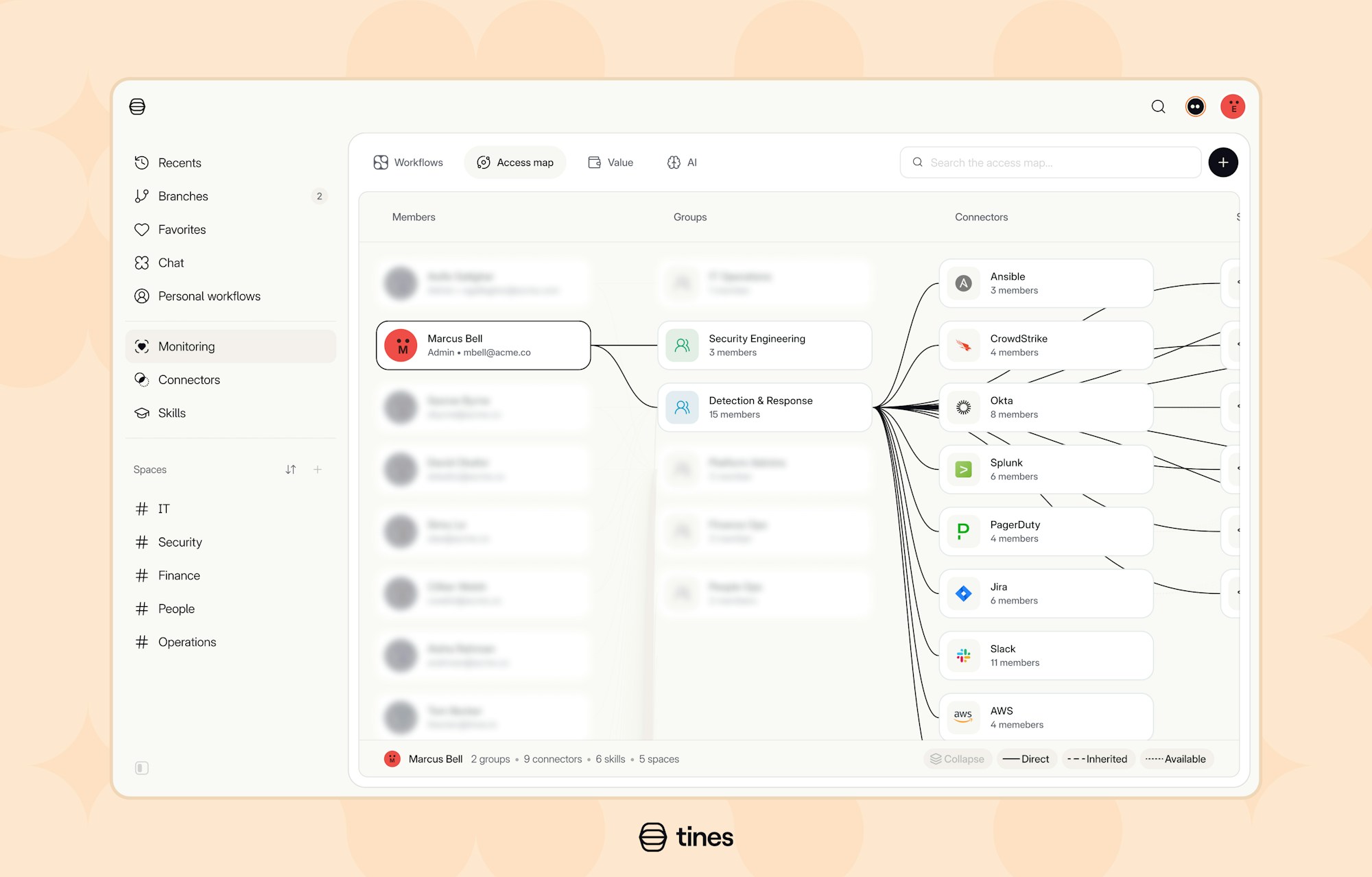
The access map in Tines 3B
Our product team saw the value of this and brought the idea into 3B. Within weeks, Brandon’s project became the access map, a feature now available to all customers as a core part of the monitoring aspect of our platform. Our security, IT, and internal operations teams weren’t simply early users of 3B. They helped shape some of its most important features.
As our teams built rapidly, our space architecture — how we organize who’s building and where — needed to evolve. We began with a space per organizational unit (engineering, marketing, sales etc.), but soon teams began asking for more dedicated spaces for smaller, more focused groups to build more sensitive workflows, or broader groups for safer, cross-team collaboration.
The first 90 days of adoption
- 1,000+
- live workflows built by employees
- 67%
- of employees building in 3B
- 100%
- of employees using 3B builds
By the end of the first week, our teams had built more than 140 workflows across both team and personal spaces. The workflows were a real mix. Some were exploratory, just testing what 3B was capable of, while others delivered real impact from day one.
Our XDR team built an intent dashboard that surfaces better account and lead signals than Salesforce could on its own, helping the team prioritize and act on opportunities faster. Our revenue operations team built a total of 26 workflows that first week, including one that manages the state and stage of Salesforce objects automatically, speeding up deal desk processing.
Week 2 kicked everything into overdrive. We held our first internal hackathon for European Tinos, run by our community team. The result was an explosion of creativity: a 300% surge in workflows, totaling over 500 active automations, running tens of thousands of times. The hackathon sessions for our global teams invited hundreds of ideas, production workflows, and proof of value concepts for our Example Gallery, to help inspire our customers.
What this means and what’s next
The thing I'm most excited about is how Tines 3B has been embraced by everyone on the team. There's a phrase that's crept into nearly every internal conversation: "I'm working on a fix in 3B." Not "I wish we had X." Not "Should we look at a tool to help with Y?" Just: "Give me an hour and I'll build it."
"I'll build my own solution" became the default response to friction. This, of course, is only possible because 3B’s AI governance layer gives IT and security control over what people build, and what systems and data their workflows touch.
"I really appreciate the flexibility when you build with Tines 3B. When something about my process changes, I can add new functionality to my app right away. There's no waiting around for someone else to help out."
Megan O'Hearn, Senior Customer Marketing Manager, Tines
This doesn’t mean that Tines Stories is going away. Many of our most important, longest-running workflows still live there. What it means is that we now have two incredibly fast and effective paths to solving problems, instead of just one.
Some workflows we built eight years ago are still running strong today, and are now even supporting new Tines 3B initiatives. Our lead management workflow, for example, has been running in Tines Stories since the early days, and now calls out to 3B to handle tasks like creating new 3B records in our CRM.
Meanwhile, the pace of 3B adoption isn't slowing down — it's speeding up. Over just the last four weeks, our teams shipped an average of 139 new workflows a week in 3B, on top of the workflows still being built, run and monitored in Stories every week. Three months in, 3B already accounts for 20% of workflows ever built at Tines, a sign of how much value it’s adding.
Naturally, this pace of adoption raises questions about AI costs, app sprawl, and more. Even though it's early days, we're confident that the benefits of Tines 3B outweigh those challenges, and we expect that value to compound over time. We’ll share more on this soon, and also take a closer look under the hood at some of the most impactful workflows our teams have built, breaking down the logic, the cost savings, and how you can replicate these in your own 3B tenant.
It really feels like we're only scratching the surface.
Want to try Tines 3B for yourself? Get started for free.