

As recruiters, we want to spend our time on people, not paperwork. But every new hire comes with admin, and at a fast-growing company, that can quickly add up to hours of essential-but-tedious work every week.
At Tines, we were manually piecing together contracts using location-specific templates in Google Docs. It was time-consuming, easy to get wrong, and delayed getting contracts to candidates, which could push out start dates and drive up our time-to-fill metric.
So we used Tines 3B, our complete environment for building apps, agents, and automations, to create a custom piece of software that makes the process pain-free. It pulls candidate and offer details from our applicant tracking system, Greenhouse, and creates a correct, location-specific contract instantly.
The contract generator app has been huge for our recruiting team. It’s already:
Cut contract creation time by around 75%
Contributed to a 5% decrease in time-to-fill
Eliminated manual errors and the time spent fixing them
Freed up 1–2 hours per recruiter, per week, for proactive talent sourcing
Recruiters should be spending their time talking to great talent and helping them join Tines. Preparing and checking contracts was taking valuable time away from that. This gives the team more room for the work we hired them to do.
Saul Whitton, Senior Director, Recruiting
Before 3B, we were stuck working around the limits of our HR and recruiting tools. Now we build exactly what we need, in hours or days, not months.
Leslie Cormier, Manager, Recruiting
"They say 'time kills all deals' — in a competitive talent market, that's just as true for recruiting. This contract generator gives us a safe, secure, scalable way to close roles faster and get top talent in the door before anyone else does."
Rachel Nieves, Senior Recruiter
The problem: a patchwork of manual, location-specific templates
With offices across NAMER, EMEA, and APAC, every Tines contract has to reflect local employment laws, which can vary not just by country, but also by US state.
Previously, we had a shared Google Drive of contract templates for every location. Legal had signed off on the template language, but assembling the correct version for each hire was awkward. There were about 20 different versions of the contract, and we had to go page by page to piece together the right parts based on the new hire’s location. “Delete this clause for Arizona, keep it for Montana,” etc.
This created a high risk of human error. When you’re manually editing base templates according to candidate details in Greenhouse, it’s easy for things to get missed. For example, a contract for a Sales Development Representative (SDR) in Boston might accidentally use standard “remote hire” language instead of specifying that they’d be working hybrid from the Boston office.
In other words, the initial contracts weren't just time-consuming to create, they were also likely to contain mistakes, which meant even more rework down the line. And it wasn’t just our time that was affected: delayed contracts can push out start dates, leaving teams short-staffed and creating poor candidate experiences.
Contracts are so time-sensitive. Candidates have to give the right amount of notice to their current employers, so even a day or two of a delay can have real knock-on effects.
The solution: an employment contract generator, built with Tines 3B
Greenhouse’s native contract generation couldn’t handle multi-state compliance needs. It required us to make a separate template for every state, which meant more work for our team. So we turned to Tines 3B to create an app that generates the contracts for us, based on our exact needs.
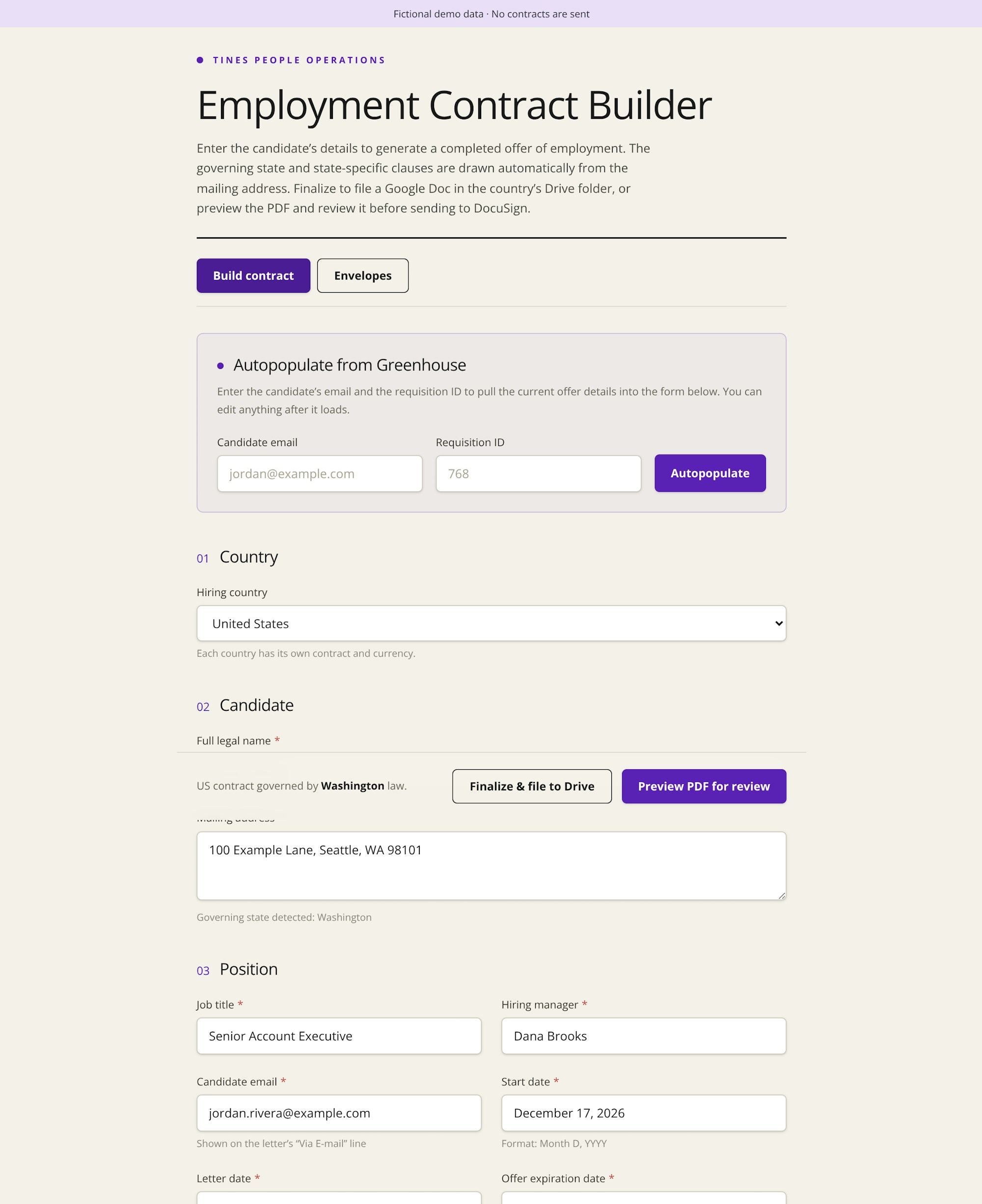
Building contracts
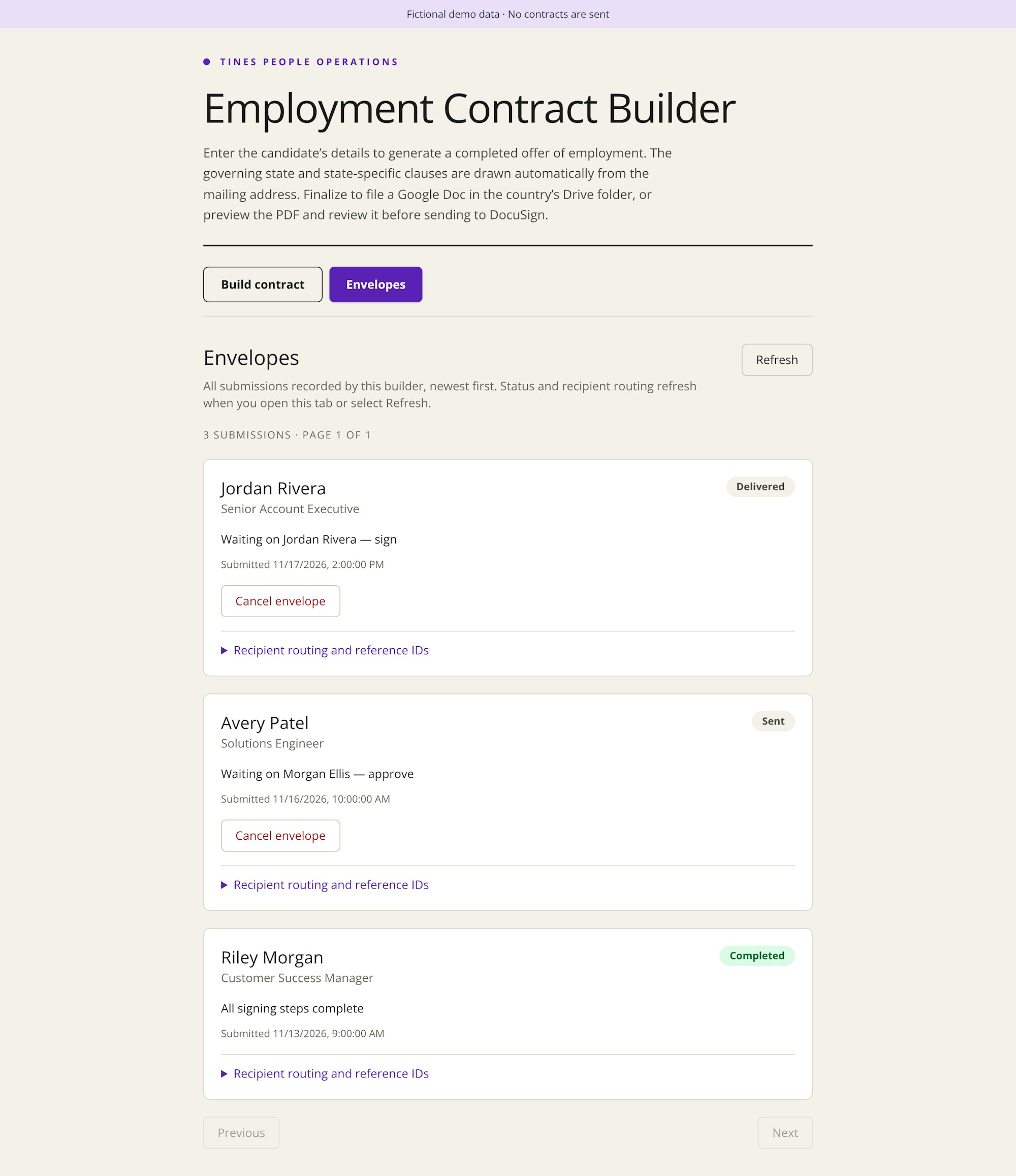
Tracking contracts
Building in Tines 3B was easy: we didn’t need any technical experience or engineering resources, and because AI governance is built in by default, we could be confident that sensitive candidate information stayed secure. The whole thing cost around $450 to build and costs virtually nothing to run.
Now, a recruiter simply follows a link in Tines 3B, then inputs the candidate’s email and the Greenhouse requisition ID. The app pulls all the offer details from Greenhouse and auto-generates the correct contract version, based on the candidate’s state or country, role type, and whether they’re hybrid or remote.
The recruiter can quickly review the contract, download it as a PDF, and upload it to DocuSign to send to the candidate. Our plan for the next phase is to integrate DocuSign directly into the workflow, so we can skip the manual download and upload step entirely.
The impact: faster, more accurate contracts, and more time for talent sourcing
Time saved and reinvested
Contracts used to take 15 - 20 minutes to create, now they take five. Over the course of a week, those time savings add up, winning back 1 - 2 hours that each recruiter can spend on proactive talent sourcing — something we can never have enough time for.
Saving 1 – 2 hours a week is huge for our team. It’s more time we can spend sourcing great talent for the company.
Improved accuracy
We’ve eliminated manual errors, like missing state-specific clauses or using incorrect location language, which also cuts down on rework and back-and-forth with candidates later. And when company-wide language changes — like an update to our legal entity name — we just change it once in Tines 3B and it’s reflected everywhere, instead of manually updating dozens of individual templates (and always worrying we’ve missed one somewhere).
Faster turnaround
In the past, a 5pm Slack request to send out a contract would mean the candidate wouldn’t get it until the next day. Now, we can get a contract into the DocuSign queue within 5 minutes. Getting contracts out 4x faster and freeing up time for talent sourcing has also contributed to improving our time-to-fill, which has decreased by 5% in the space of a few months.
The app cuts down the time we spend on each contract, and it also speeds up the turnaround time to get them out to candidates, so we can get candidates signed and started sooner.
What’s next?
As well as integrating DocuSign into this workflow, we’re working on some other builds in Tines 3B to help our recruiting teams work faster. These include a candidate briefing app, an offer letter generator, a candidate debrief prep assistant, and a recruiter pipeline dashboard.
Final thoughts
No one gets into recruiting because they love generating contracts. But it needs to get done quickly and correctly, so it always becomes priority number one. Before you know it, you’ve spent all day on manual admin, and haven’t been able to block out time for high-impact talent sourcing work. Our contract generator lets us cut out this muckwork, so we can focus on filling roles with the right people, faster.
Looking to build your own contract generator? Check out Leslie's entry in the example gallery. Sign up to try Tines 3B for free, import the complete app, and connect it to your tools.