

The June 2, 2026 White House Executive Order on Promoting Advanced Artificial Intelligence Innovation and Security has officially set the clock ticking. With mandates requiring CISA and federal agencies to deploy AI-enabled defensive tools on civilian systems, the directive for Federal CIOs, CISOs, and SOC Directors is clear: AI adoption is an operational requirement to effectively defend federal networks.
The real challenge is figuring out how to strategically and operationally use AI to scale capabilities while effectively managing costs and reducing the risk of shadow AI.
AI is here to stay, but without the right strategy, its financial toll and uncontrolled usage risks will continue to climb.
Why the AI SOC conversation now?
The industry hype around the "AI SOC" concept is driven by a very real catalyst: the rapid advancement and widespread availability of powerful LLM technology, and the development of Mythos and other similar cyber-focused models. Because agencies now have access to advanced models, a wave of market hype and new technologies have emerged, pressuring security leaders to believe that a fully autonomous, AI-exclusive platform is required to survive modern, fast-moving threats.
But here is the reality: you don't need to rip and replace your existing infrastructure for a standalone, AI-only tool. While AI capabilities are undoubtedly necessary to handle complex data synthesis, they aren't a standalone silver bullet. Traditional deterministic workflows and high-speed scripts still play a vital and irreplaceable role in modern defense. They provide a foundation of resilience through speed, predictability, and transparency — and the best part is, you can actually use AI to rapidly generate and execute this deterministic code. True enterprise resilience comes from an iterative approach, seamlessly layering AI intelligence onto the proven deterministic workflows and scripts you have already worked hard to build.
The strategic solution
As agencies rush to build out these capabilities, many drift toward niche, "AI-exclusive" platforms. However, relying on a fully autonomous SOC can create operational friction points:
Speed: Purely agentic workflows are inherently slow and have difficulty truly scaling across thousands of alerts. Forcing an AI model to sequentially reason through every basic parsing step introduces significant latency when seconds matter most.
Cost: Pushing every routine, repetitive alert through an LLM backend triggers compounding token costs for cognitive compute that was entirely unnecessary.
Human oversight: Fully autonomous platforms make it difficult to insert effective human-in-the-loop capabilities, allowing for human judgment at the decision points where it's legally or operationally required.
Risk: Relying solely on LLMs opens the door to organizational security risks. Without deterministic guardrails, organizations face the constant threat of AI hallucinations, prompt injection attacks, data poisoning, and context window limitations. This potentially limits and puts their defensive incident response and security capabilities at risk.
The next-generation Federal AI SOC solves this by recognizing that the answer isn't a purely autonomous system, it’s a hybrid model. By pairing advanced agentic capabilities with high-speed, zero-token-cost deterministic workflows, you get the best of both worlds. You continue to benefit from the speed, reliability, and predictability of traditional deterministic logic for routing and routine tasks, while reserving slower, more expensive AI reasoning loops strictly for complex threat analysis and data driven decision making capabilities.
This balanced approach delivers maximum operational scale on your own terms, keeping costs and risks tightly controlled without sacrificing velocity or visibility.
What we'll cover
In this blog post, we'll look past the marketing hype to lay down an operational AI SOC blueprint built for the modern federal enterprise.
Specifically, we'll look at:
Flexible AI SOC architectures: Three design blueprints that balance autonomous intelligence with strict deterministic controls — and show how each manages speed, token cost, risk, and human oversight in practice.
Core platform capabilities: The native orchestration features that move you from concept to operational workflow, without rebuilding what you've already deployed.
We'll close with a look at where this foundation leads: scaling automation beyond the SOC into a unified AI cyber fusion center.
AI SOC architectures: your designs, your control
To build a resilient AI SOC, federal agencies require defensive capabilities that map directly to their specific missions, technical environments, and operational constraints. Tines delivers this by empowering security teams to build custom, AI-powered SOC workflows that seamlessly balance autonomous intelligence with strict deterministic controls and human oversight.
Because every workflow in Tines is fundamentally built on top of your existing API integrations, you dictate exactly when, where, and how an AI agent is utilized.
This integration-first foundation ensures you never have to choose between full autonomy or zero intelligence; instead, Tines provides the full spectrum of automation on your own terms. You have the flexibility to build an AI SOC architecture that conforms to your standards, practices, capabilities, and limitations.
Crucially, this flexibility allows you to natively align your AI SOC with whatever incident response framework your agency has adopted, whether that is NIST SP 800-61, PICERL, Cyber Kill Chain, or the classic OODA loop. While the following three architectural pattern examples provide a technical blueprint, they are completely customizable to your agency's exact capabilities and constraints.
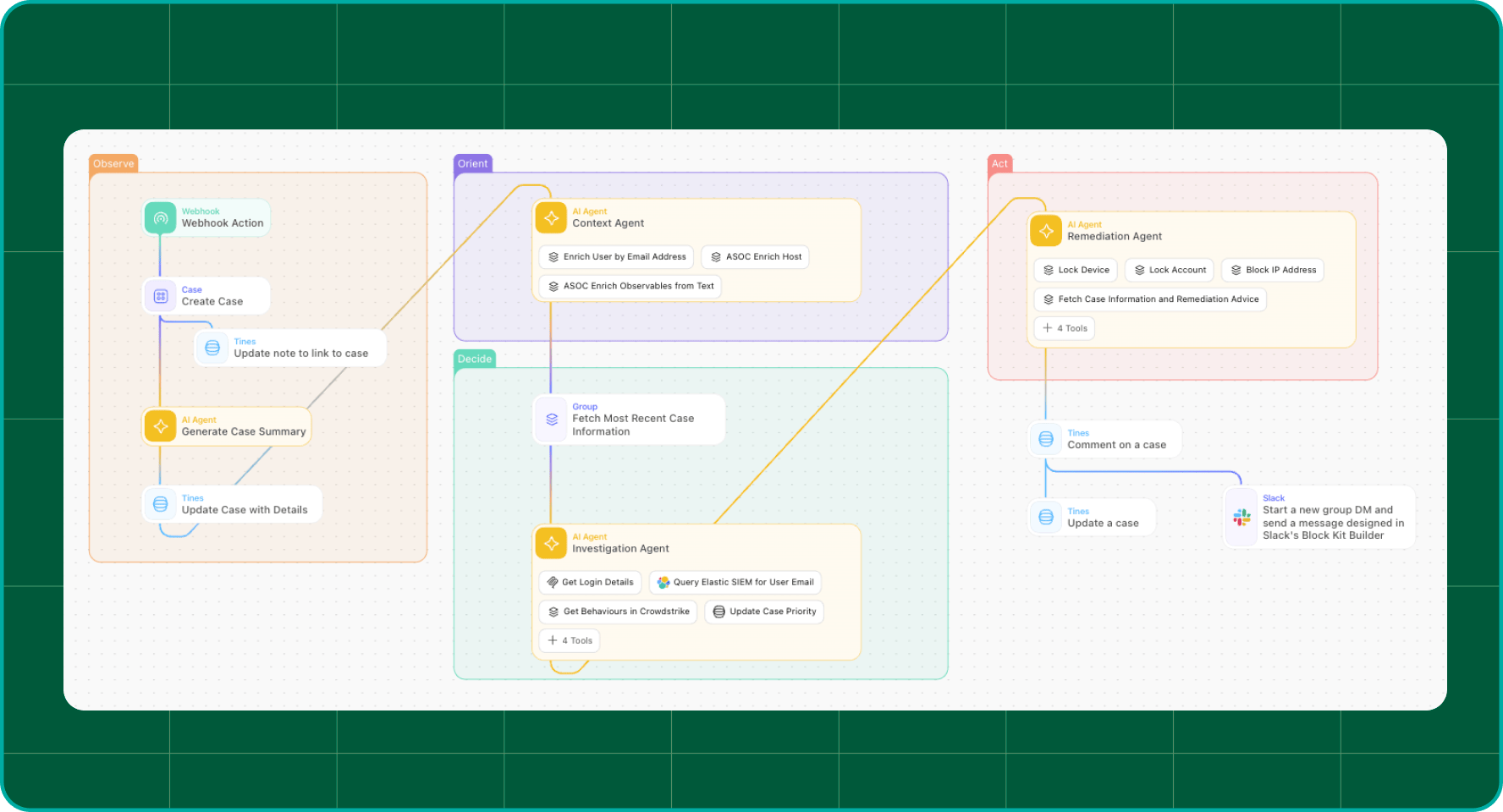
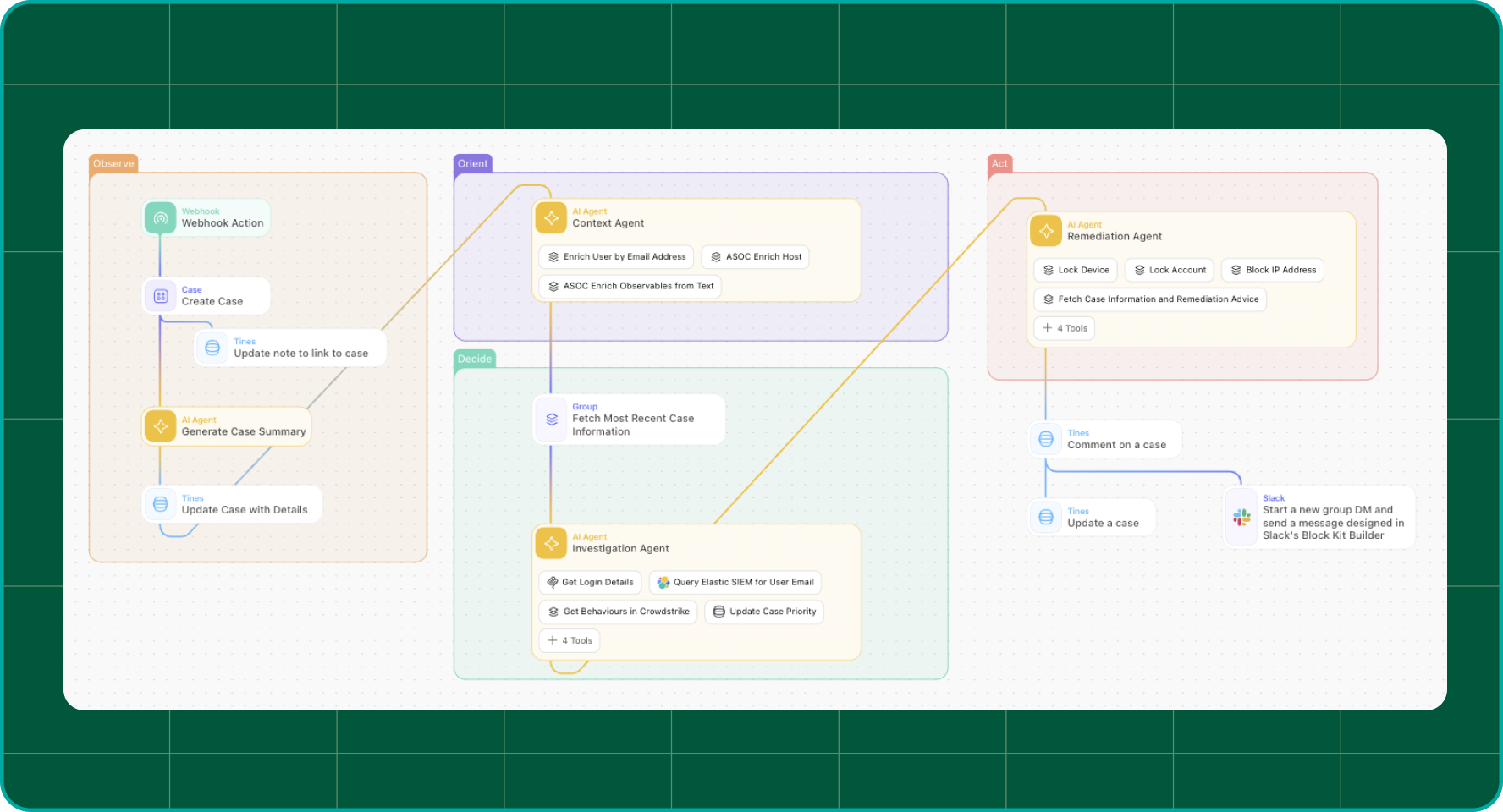
1. Autonomous Closed-Loop Architecture (Zero-Touch OODA)
Architecture: Linear agent based event processing with deterministic stories
The concept: This represents the “work horse” of an AI SOC workflow, a highly scalable and linear approach to utilizing agents engineered for machine-speed execution on high fidelity low impact alerts. Here, LLM agents operate with autonomy across the entire Observe, Orient, Decide, and Act (OODA) loop, executing end-to-end pre-determined response actions only stopping to request human intervention on a suspected incident or critical case designation. Speed is accomplished by agents leveraging existing deterministic Tines Stories that interact with other solutions via API at machine speed.
How it works in Tines Stories: An alert is ingested directly into Tines Stories via an API webhook. From there, autonomous agents immediately gather context, query internal logging systems, and cross-reference threat intelligence. If the agent's confidence score crosses a pre-defined threshold, it directly triggers remediation sub-stories, such as isolating a compromised host or blocking an IP address, driven entirely by data gathered through tooling and its own automated reasoning. If the agent identifies that the cyber event is a critical priority or deemed a real incident, the case will be assigned to a human and escalated accordingly.
Best for: High-fidelity, low-impact alerts where the cost of a potential false positive is negligible compared to the critical need for immediate, machine-speed containment.
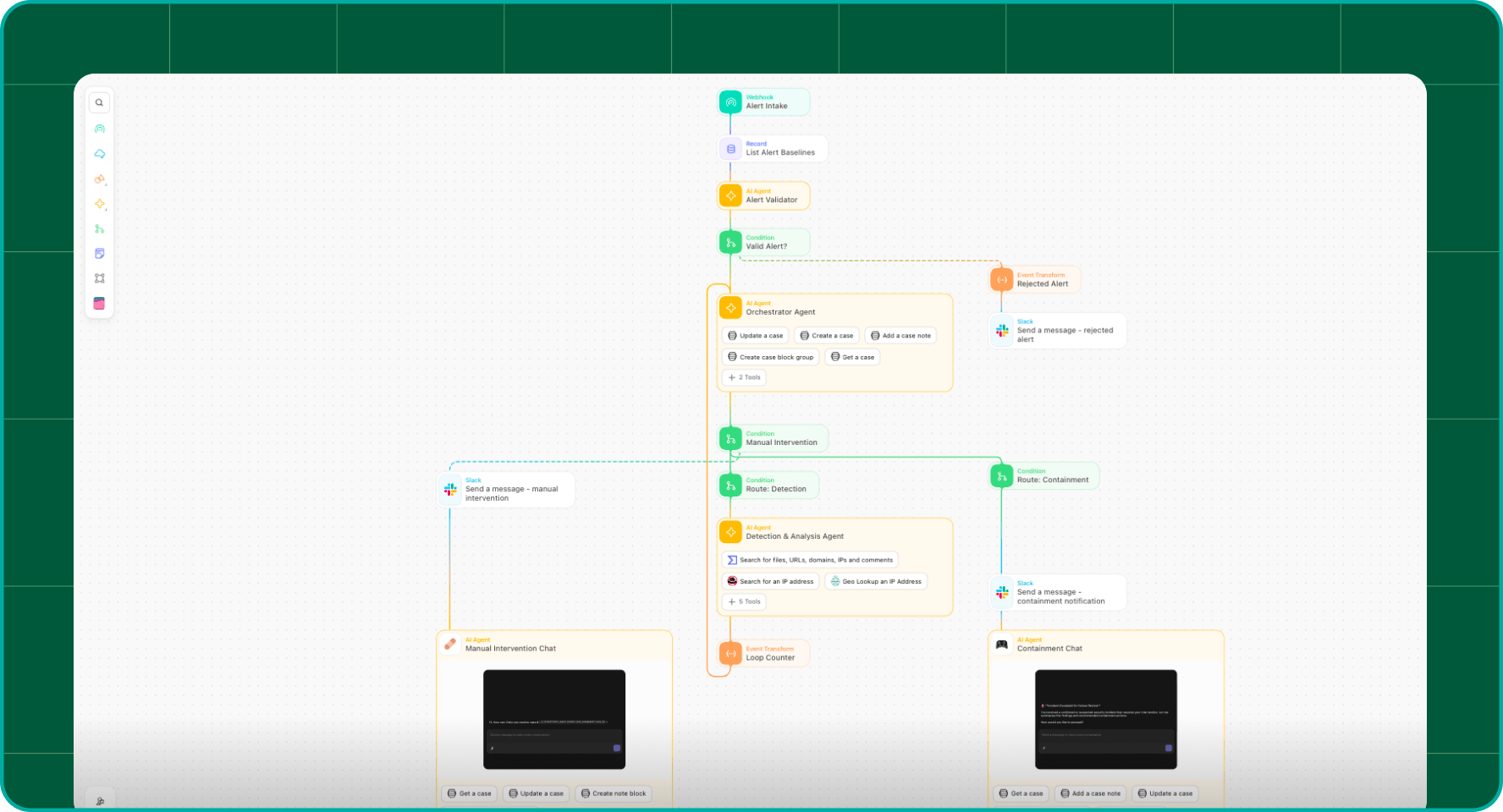
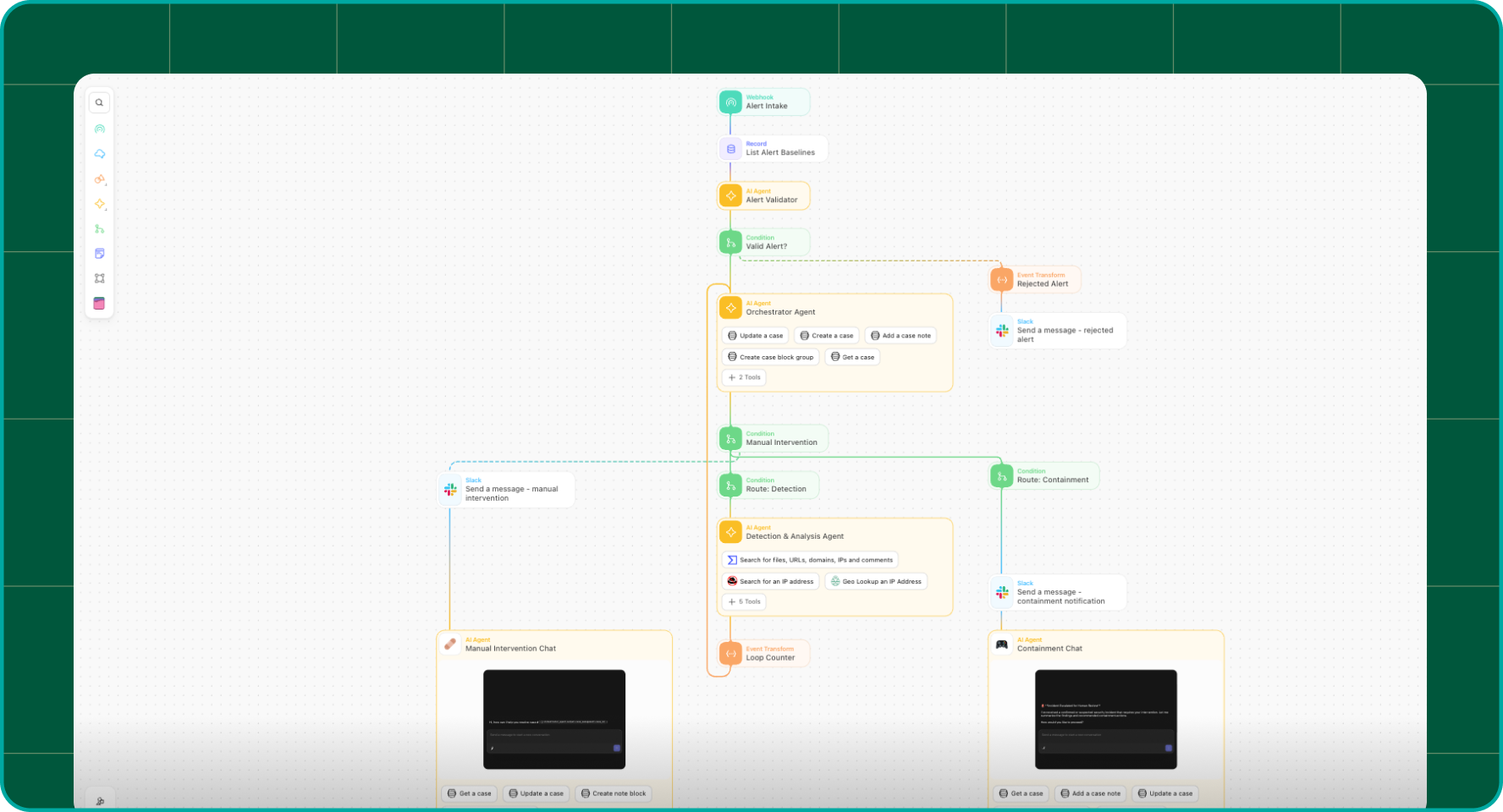
2. Hierarchical Swarm Architecture (Delegated AI with HITL Guardrails)
Architecture: Fully agentic - agent looping with tool calling
The concept: This architecture mirrors a high-functioning security team, positioning a primary Orchestrator Agent as a "Lead Analyst" managing multiple specialized Sub-Agents ("Junior Analysts"). Architecturally the concept leverages looping capabilities where the Orchestrator Agent can call Sub-Agents multiple times with additional instructions and parameters. While the orchestrator excels at delegating tasks and correlating complex forensics, it fundamentally lacks the authority to execute state-changing containment actions without an explicit human interaction.
How it works in Tines Stories: The primary Orchestrator Agent receives the alert and delegates distinct pieces of the investigation to specialized sub-agents (e.g., calling a Detection Agent to query endpoint telemetry, or an Intelligence Agent to scrape external indicators). The sub-agents return their structured findings to the orchestrator, which builds a comprehensive timeline. If a threat is confirmed, the payload is routed to an interactive Human-in-the-Loop (HITL) prompt or Chat Agent, presenting the complete case context to a human analyst for further investigation and final approval.
Best for: Complex, high-severity investigations, such as ransomware staging or lateral movement, where AI is required to lift the heavy burden of correlation, but human judgment remains legally or operationally mandatory before disrupting critical systems.
3. Agent-Augmented Deterministic Pipeline (Hybrid SOAR)
Architecture: Single agent with embedded sub-agents and external agents (via MCP)
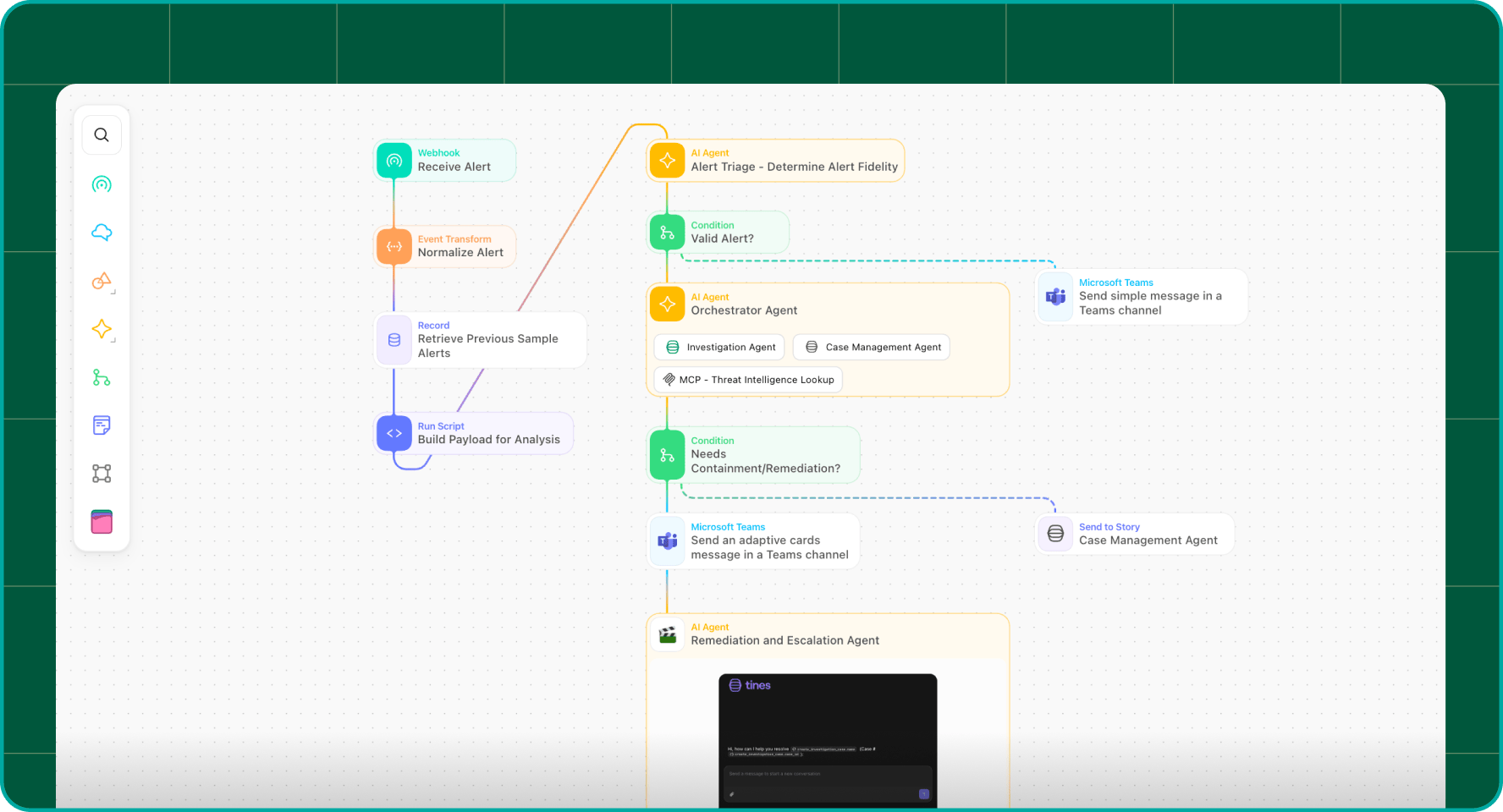
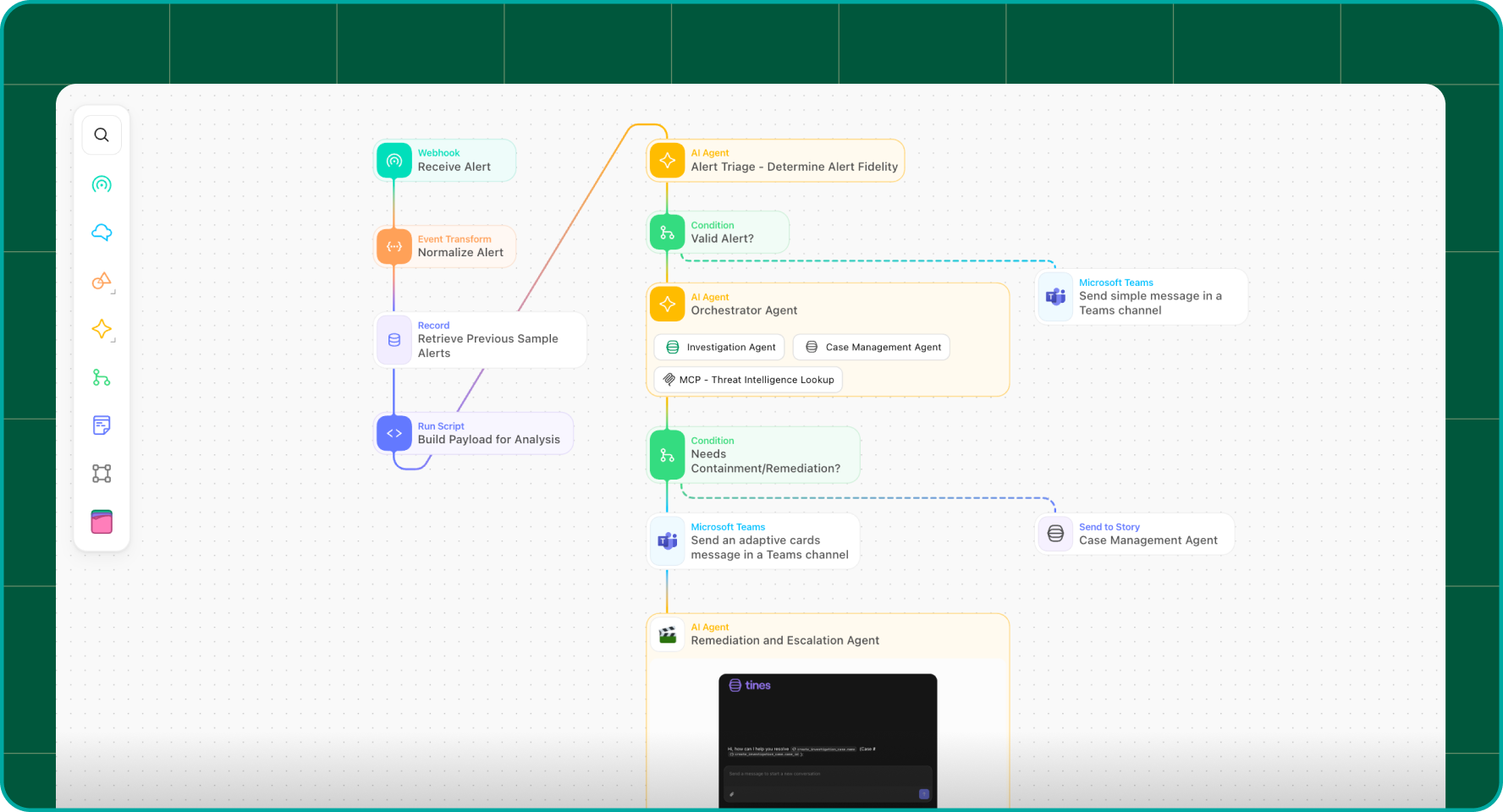
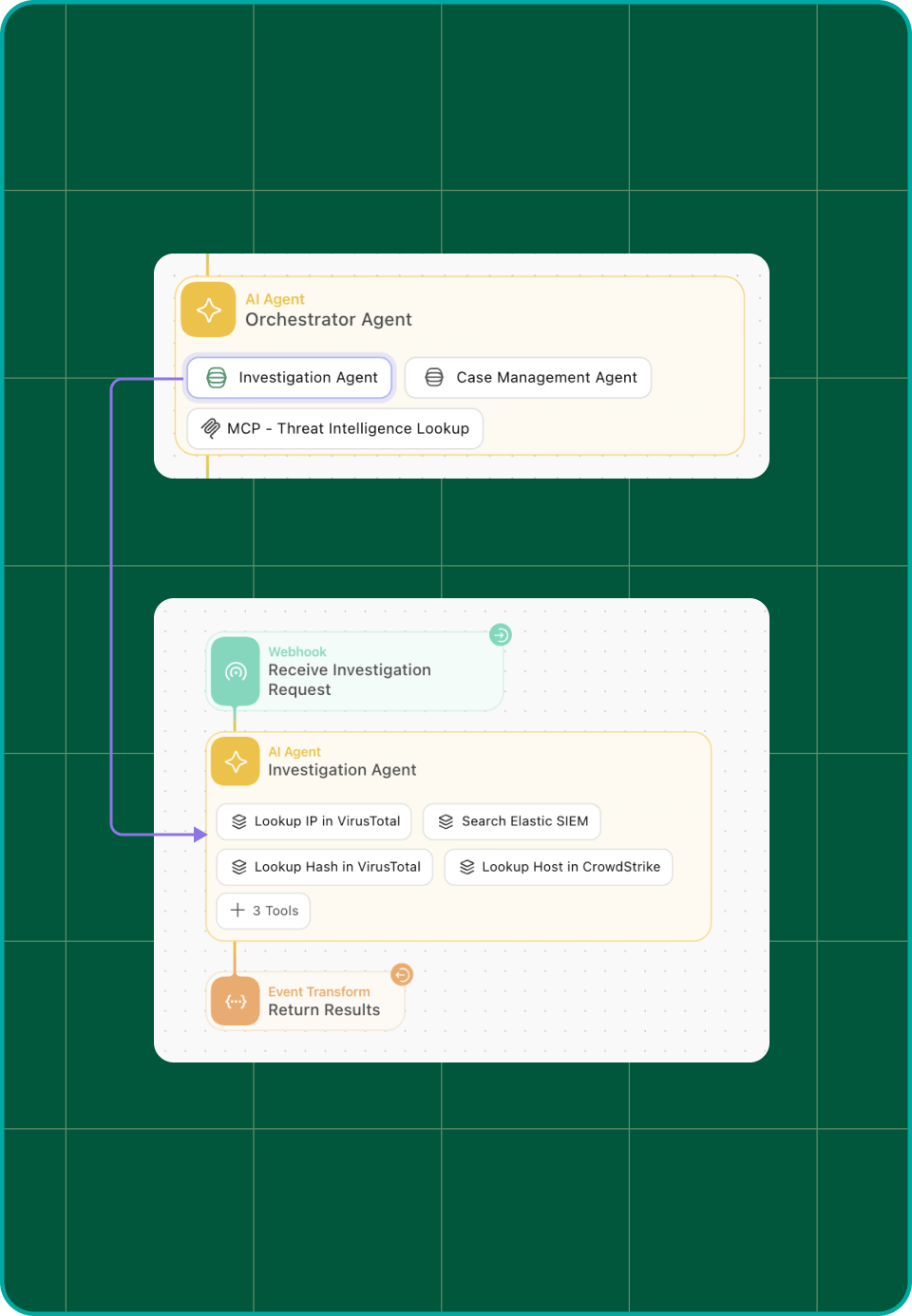
The concept: This architecture leverages a single Orchestrator Agent that calls sub-agents as its own tools, to perform an investigation within an overarching deterministic Story. The Orchestrator Agent gives sub-agents reasoning capabilities on small data sets before returning dispositions to itself. The sub-agents can call its own tools and/or deterministic stories to achieve speed, as well as call external agents (outside of Tines) via MCP server to gather additional context and information.
How it works in Tines Stories: Deterministic actions handle the initial parsing, normalization, and routing of alert data at zero token cost. Triage is then owned by a single Orchestrator Agent that calls its own sub-agents as tools. Each sub-agent performs a bounded piece of the investigation, reasoning over a small, focused data set, executing API queries and deterministic Tines Stories for speed and minimal token usage, and returns a structured disposition summary to the orchestrator. The orchestrator can also reach beyond Tines via MCP to leverage external agents for additional context, then assembles all sub-agent findings into a single triage verdict.
Best for: High-volume SIEM alerts that need intelligent triage before an analyst ever sees them, where bounded sub-agent reasoning keeps token costs minimal and the orchestrator delivers a fully enriched, correlated case ready for human investigation.
Pulling it all together: AI SOC capabilities on your terms
Whether you deploy any of the AI SOC architecture examples discussed or you build your own unique architecture, the ultimate value of building an AI SOC in Tines Stories lies in absolute execution control. You are never locked into a single vendor's proprietary logic or an unpredictable billing model. Instead, Tines provides the tools and capabilities to build an AI SOC at your own pace and on your own terms. Let's review some core Tines Stories capabilities that help organizations build and adopt the AI SOC operating model:
Workbench for Storyboard
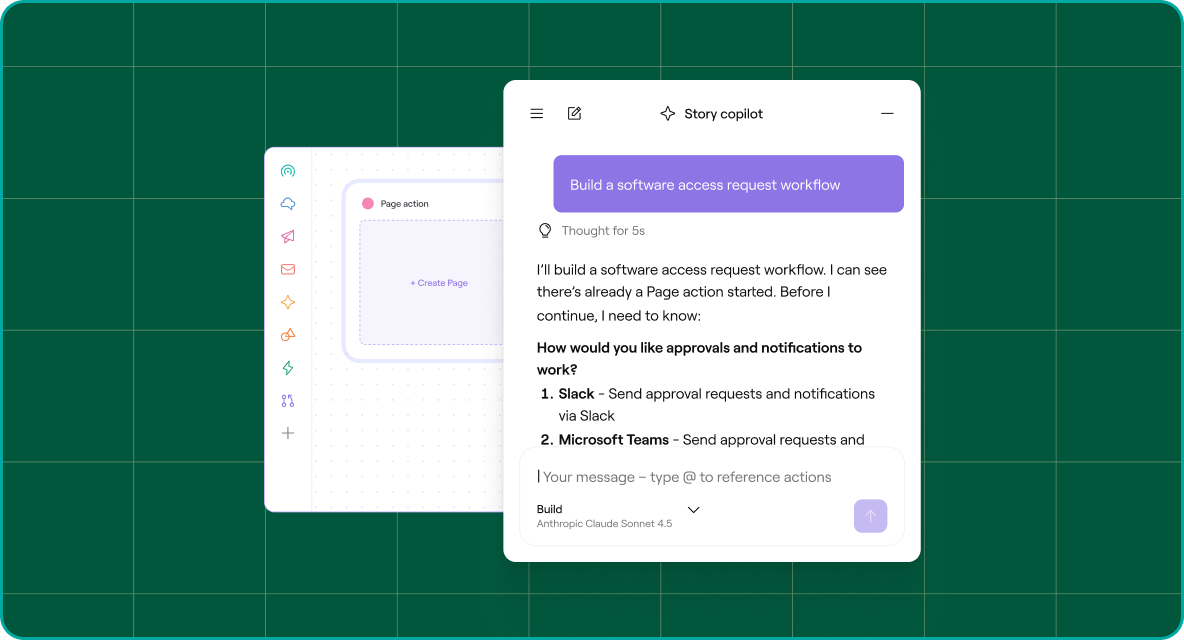
Ask Workbench for rapid operationalization: Building a simple to sophisticated AI SOC shouldn't require months of engineering. With Tines Ask Workbench, federal teams can input existing standard operating procedures (SOPs) or architectural wireframes directly into a chat interface to automatically generate production-ready workflows, seamlessly jump-starting the journey from deterministic scripts to fully agentic pipelines or a healthy mix of both.
Flexible AI Agent modes: The Tines AI Agent action supports two distinct operating modes to fit any operational use case, as demonstrated in the AI SOC examples. Task Mode allows the agent to autonomously reason, loop, and execute background tasks within a workflow. Chat mode deploys an interactive, AI-powered page for end-users or analysts to directly engage with the agent for interactive triage.
Extensible MCP tooling: Through the Model Context Protocol (MCP) integration, Tines agents can securely connect to external product servers to execute specialized tasks or query outside data repositories without losing central oversight.
Strategic LLM selection: To control token costs, Tines allows you to pick the exact model for the job. You can assign low-cost, fast models for basic data parsing, while reserving high-cost, high-reasoning frontier models for complex forensic correlation, while centrally tracking token usage across all Tines AI actions.
Deterministic Stories as tools: Agents can be equipped with existing deterministic Tines Stories as "tools". This allows the agent to execute complex, zero-token, high-speed automated sequences exactly when needed. This help speeds up the AI SOC adoption process, as you can utilize existing stories you have already built within agents.
AI agent risk mitigation: Deploying AI in a federal environment requires strict adherence to least-privilege baselines. Tines natively operationalizes frameworks like Meta’s Rule of Two, which dictates an agent should never simultaneously process untrusted inputs, access sensitive data, and execute state changes. By securely controlling AI agents using deterministic guardrails, Tines provides capabilities to mitigate risks associated with prompt injections or AI hallucinations from autonomously altering your network state.
Driving AI innovation with absolute control
The June 2, 2026 White House Executive Order has made one thing clear: AI adoption is no longer a future-looking option for federal agencies, it's an immediate operational mandate. However, answering this mandate doesn't require rushing into "AI-exclusive" tools that require you to implement and maintain another tool, and rebuild or migrate all your working SOC processes and playbooks into another platform.
True enterprise resilience is built through a hybrid approach: agentic plus deterministic.
By embedding advanced agentic capabilities directly into Tines' proven, integration-first orchestration fabric, federal security leaders can confidently address operational friction points of modern automation:
Speed is preserved: Deterministic workflows eliminate high-volume noise at machine speed, so agents reason only where reasoning adds value.
Costs stay predictable: Granular model selection and zero-token deterministic execution mean you never pay for cognitive computation on routine tasks.
Analysts stay in command: Human-in-the-loop checkpoints keep your analysts firmly in control, ensuring human oversight remains paramount where you see fit.
Risk is structurally contained: Deterministic guardrails and least-privilege agent design ensure untrusted inputs can never autonomously execute critical state changes.
Looking ahead: the AI cyber fusion center
The true power of this deterministically agentic framework is its limitless scalability. The workflows and custom architectures you build today to secure your SOC don't have to stop at the security perimeter. Because Tines connects seamlessly to any tool with an API, this same orchestration layer can organically expand into network engineering and IT operations.
By unifying your security operations with your Network Operations Center (NOC), your agency moves past localized automation and steps into the future: a fully integrated, mission-first AI cyber fusion center. You don't need to rip and replace your infrastructure to survive modern threats.
With Tines, you can build the next generation of federal defense today, completely on your own terms.
Learn more about intelligent workflows for federal agencies.