

If you walked the floor at Black Hat this year, you likely noticed a glaring trend: the AI Security Operations Center (SOC) is no longer a bleeding-edge novelty. It’s officially a commodity.
With close to 70 AI SOC platform companies vying for attention, the market is completely saturated. What was once the hottest standalone category in cybersecurity is rapidly becoming a standard feature.
Today, major SIEM incumbents like Splunk, Sentinel, and Chronicle are shipping native AI triage out of the box. AI SOC automated the "easy part" of the job; improving Mean Time to Detect (MTTD) and making dashboards look green, but it has left security teams drowning in a new problem: the decision gap.
Faster triage just means more decisions queued up for human analysts.
So, if everyone has an AI SOC, what is the actual differentiator? In the age of agentic AI and Large Language Models (LLMs), the answer is shifting from buying a rigid, black-box point solution to building your own.
The rise of the agentic security operations platform
When an entire category gets commoditized, the underlying infrastructure becomes the real prize. Security teams don't need another copilot that simply summarizes alerts; they need deterministic, agentic workflows that actually eliminate manual decisions.
Because LLMs are so accessible, the barrier to entry for building automated security workflows has plummeted. You no longer need to rely on a vendor's predefined playbook. Instead, the industry is pivoting toward platforms that give IT and security teams the foundational building blocks to construct their own highly tailored, enterprise-grade AI SOCs. This is exactly where Tines is changing the conversation.
Enter Tines 3B: prompt-to-platform automation
Tines recently introduced Tines 3B, a solution designed to act as the safe, unified environment where human ingenuity and AI agents intersect. Rather than forcing you into a rigid SOC mold, Tines 3B allows teams to build custom, agent-driven workflows seamlessly.
The standout capability here is how Tines leverages prompts. With Tines 3B, analysts don't need to write complex code to stand up a new security workflow. By simply inputting a well-structured prompt, the platform can generate an enterprise-grade, fully customizable automated solution.
Here is why this fundamentally solves the commoditization problem:
It eliminates the "decision gap": Rather than just surfacing enriched alerts for a human to review, Tines allows you to build workflows that take action: isolating machines, blocking domains, or validating identity — directly from a prompt.
Total customization: Off-the-shelf AI SOCs often fail because they don't understand your unique environment. Tines 3B allows you to map automation exactly to your internal processes, turning a generic LLM prompt into a highly specific, operational reality.
Governance at machine speed: As autonomous AI agents take over more tasks, ungoverned AI becomes an attack surface itself. Tines 3B provides the secure sandbox where IT and security can actually see, govern, and constrain what these automated workflows are doing. Instead of paying a premium for a repackaged LLM wrapped in a shiny SOC dashboard, modern security teams can use Tines to prompt their own autonomous SOC into existence, built exactly to their specifications.
Introducing an AI SOC built with Tines 3B
It’s been three weeks since I stepped into the Field CISO role at Tines, and the technology has completely blown me away. While Tines is already well-known for Tines Stories, our powerful intelligence workflow automation platform, the July launch of Tines 3B is a massive step forward that perfectly aligns with where the industry is headed.
I built my very first creation in just 23 minutes — I timed it!
I've spent a little extra time fine-tuning the capabilities since then, but the results so far have been nothing short of incredible.
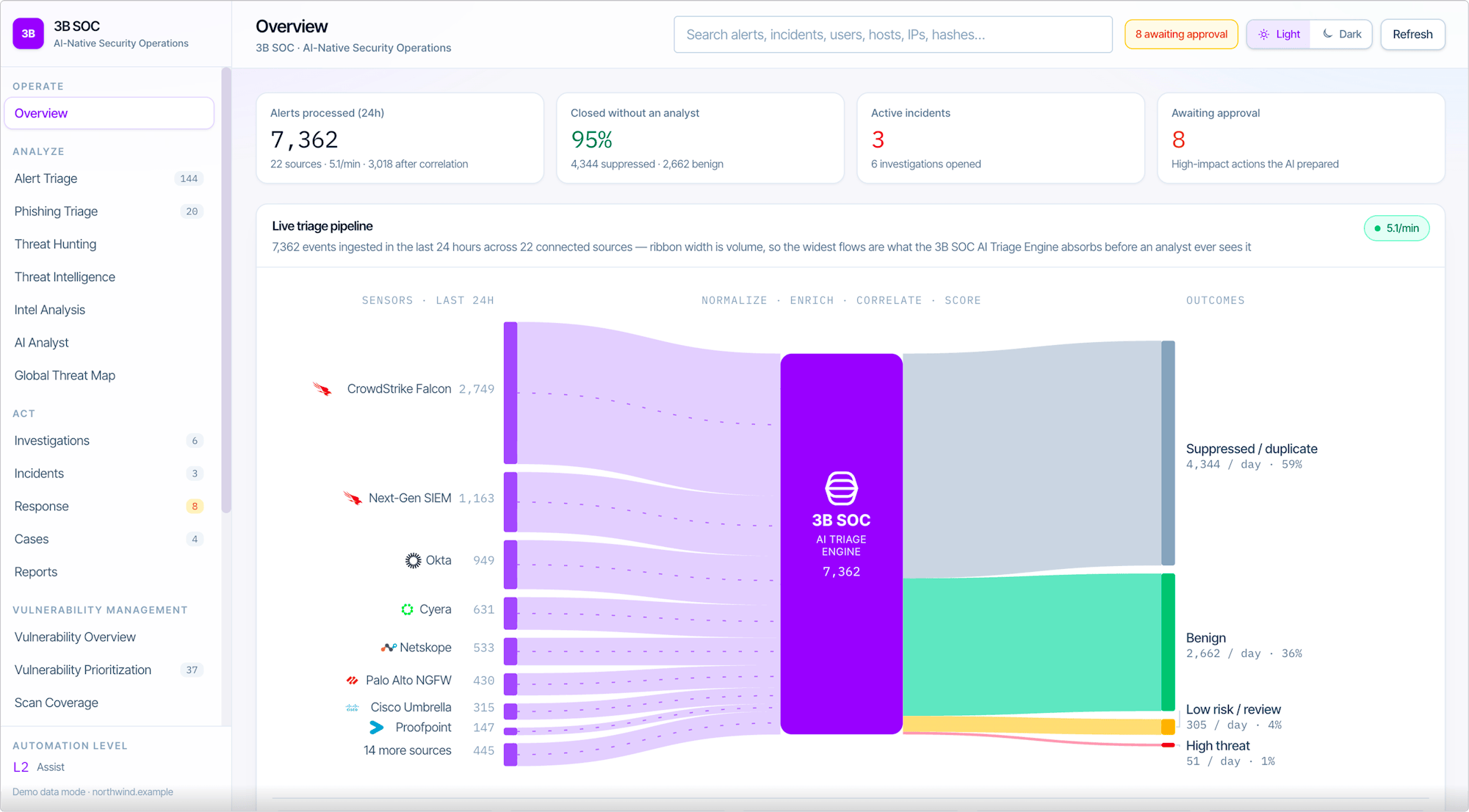
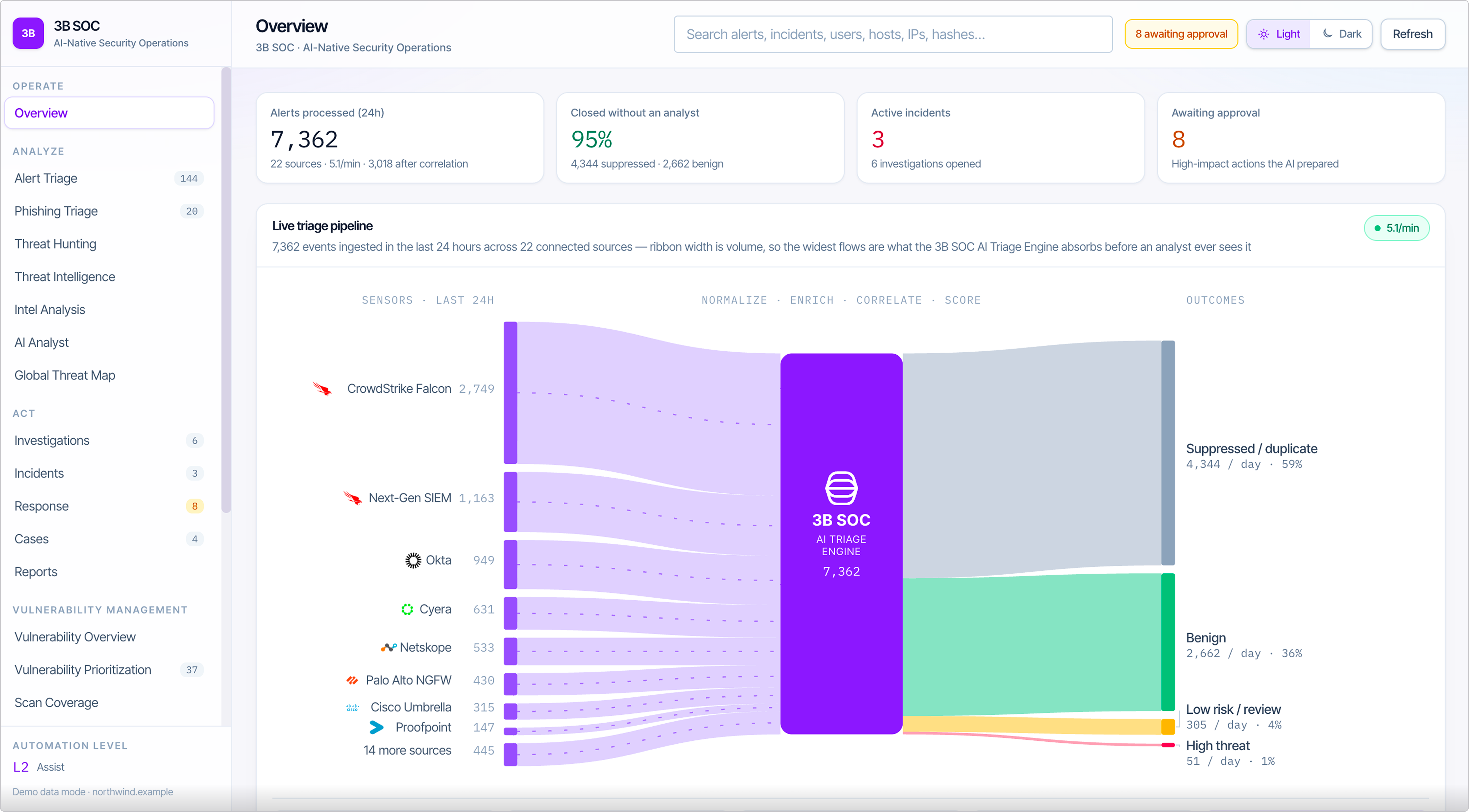
The foundation is a sleek command center that displays real-time alert telemetry and flags high-risk events for instant triage. Every element is fully customizable, giving you complete control over the layout, colors, logos, and overall design. If you scroll down further on this dashboard, you’ll be hit with a number of metrics being tracked including your environment’s security posture, SOC performance such as MTTD, MTTR, FP rate, etc. and active incidents being investigated.
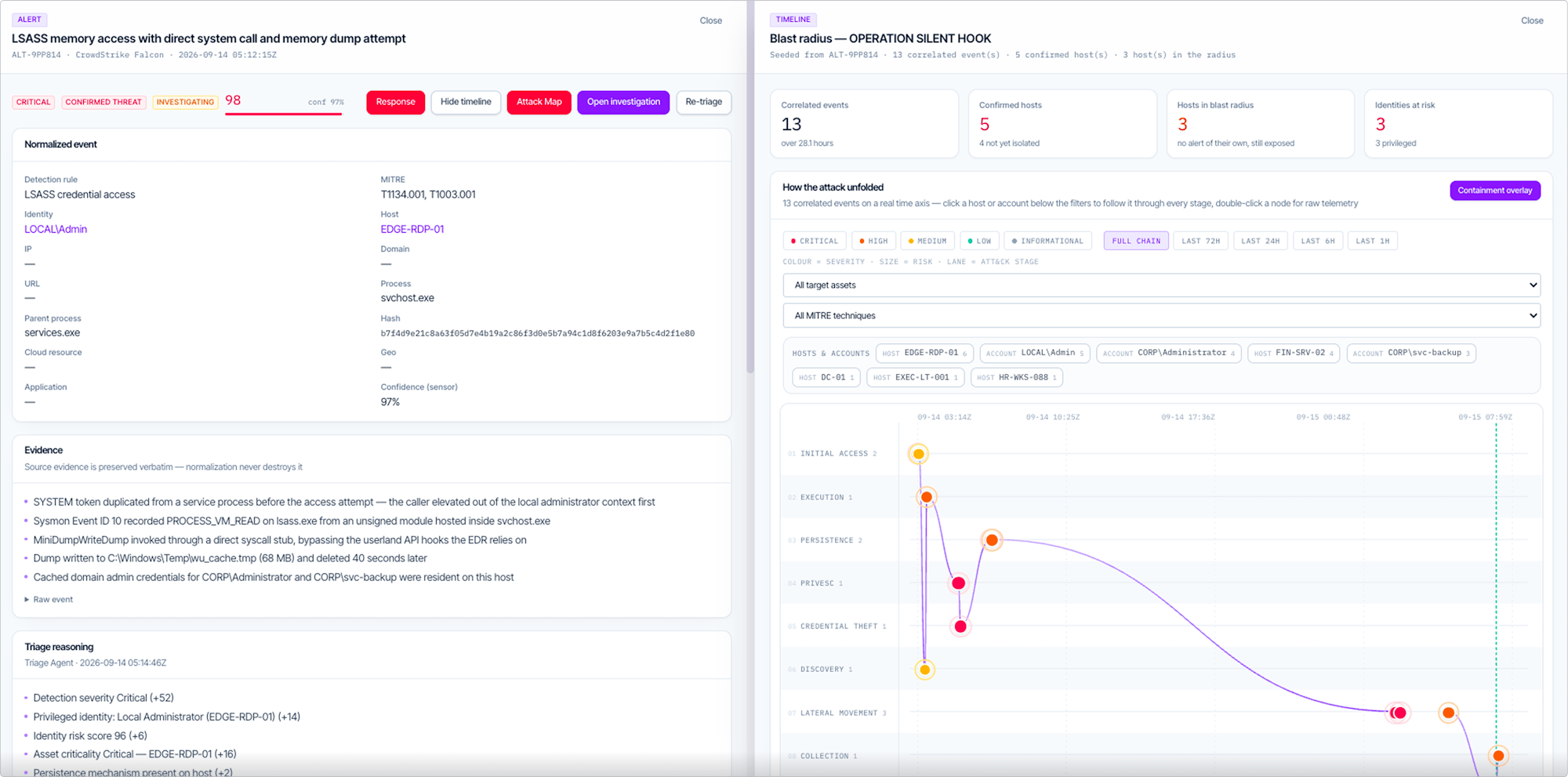
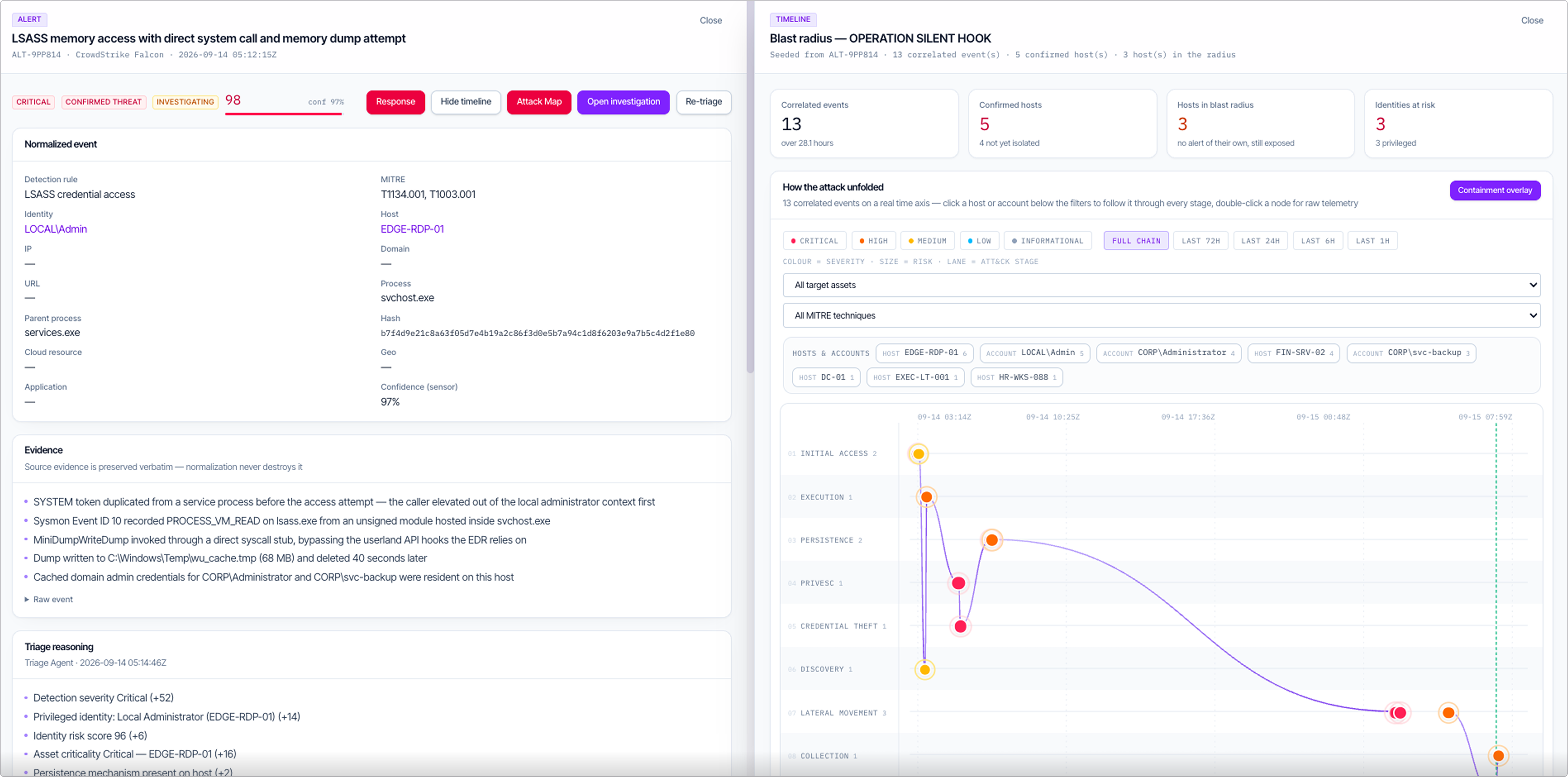
Within the Alerts section, analysts can instantly drill down into specific events to accelerate their investigations. The platform equips you with:
Aggregated context: All relevant metadata and collected evidence are centralized to eliminate endless pivoting.
Explainable AI: Transparent AI triage reasoning shows you exactly how the platform reached its conclusion, building trust and validating your workflow.
Dynamic blast radius (my favorite feature): A clear visual map of the attack's lateral movement, highlighting exactly which endpoints and identities are compromised.
Rapid containment: Seamlessly transition from investigation to remediation with built-in response mechanisms for immediate endpoint isolation and identity deactivation. Containment configurations can all be automated as well for high-risk / low-impact events to prevent an adversary from reaching any of their objectives.
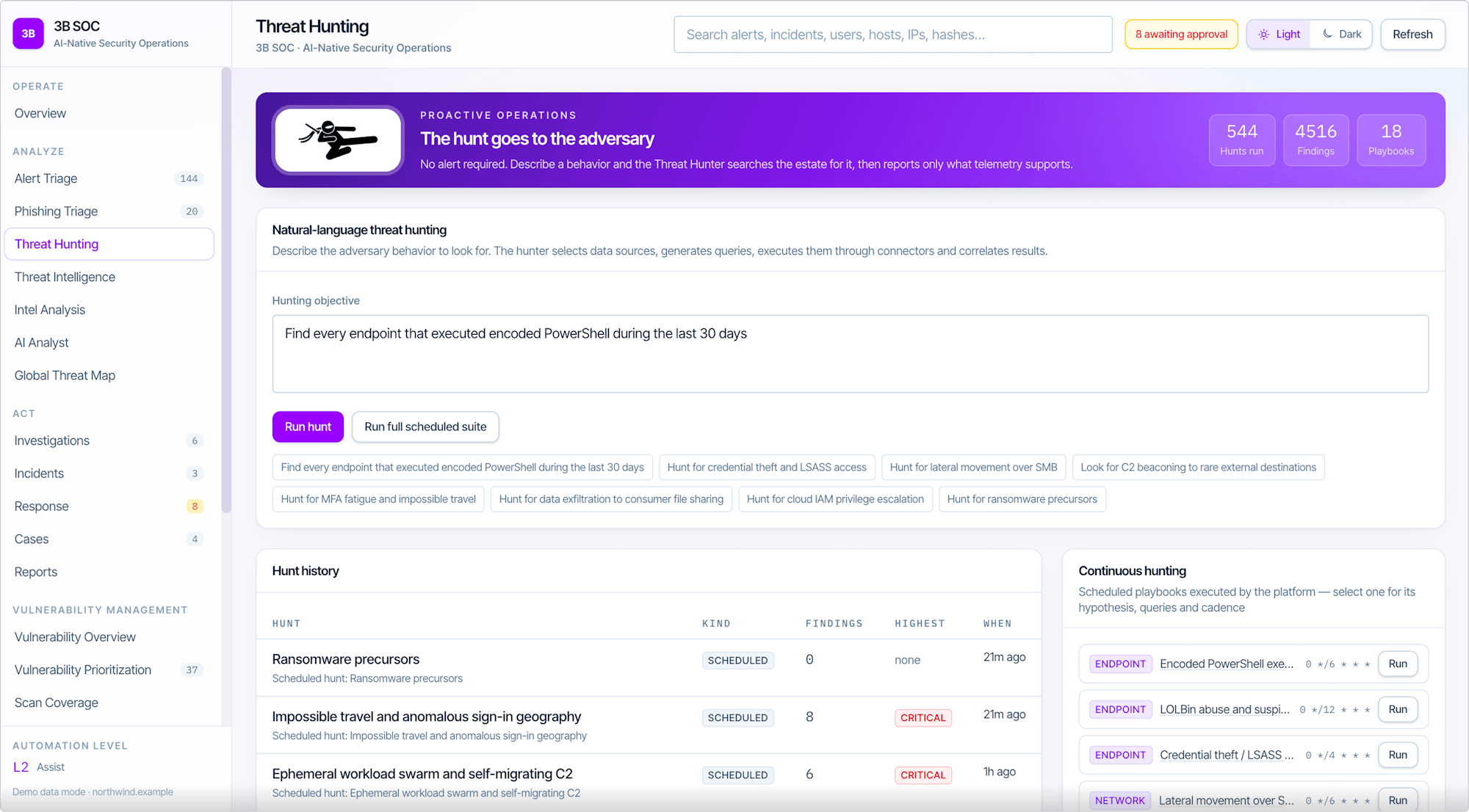
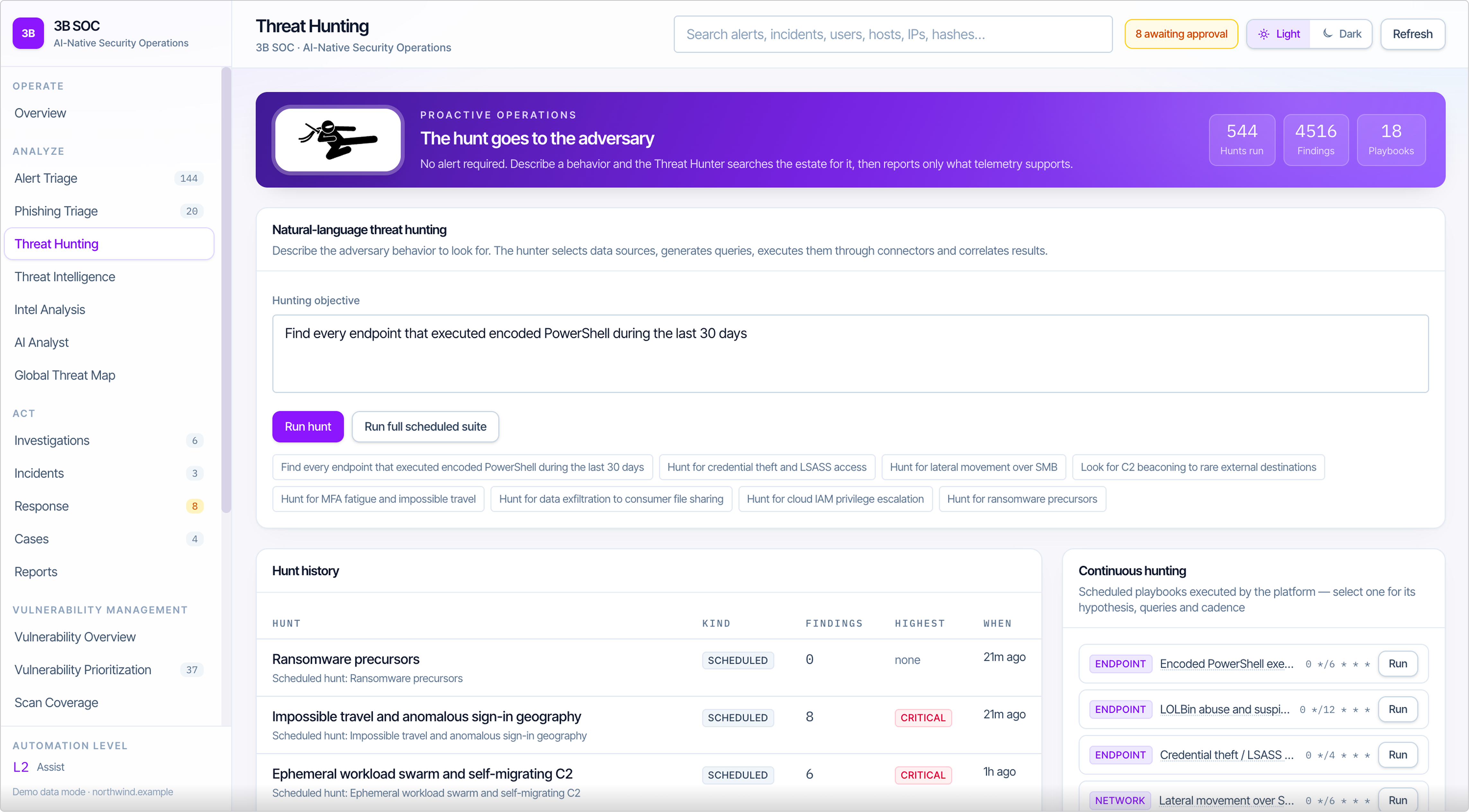
Threat hunting shouldn't require a Ph.D. in query languages. This dashboard lets you hunt for adversaries using simple, plain English and pre-built templates for threats like ransomware. While you run ad-hoc searches, the platform automatically runs continuous hunts in the background. With everything tracked in one place and an easy global search, it just makes finding and stopping threats incredibly fast and straightforward.
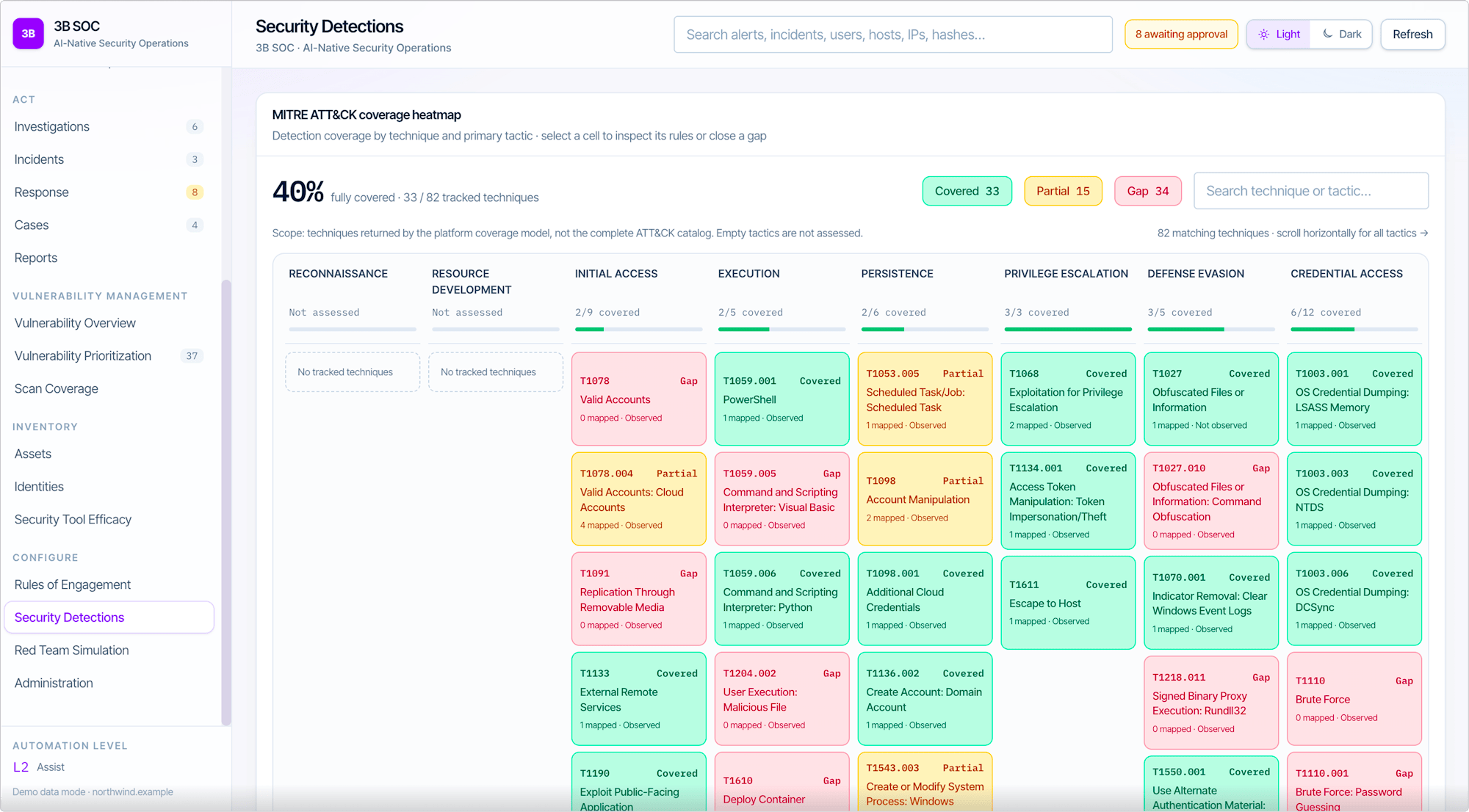
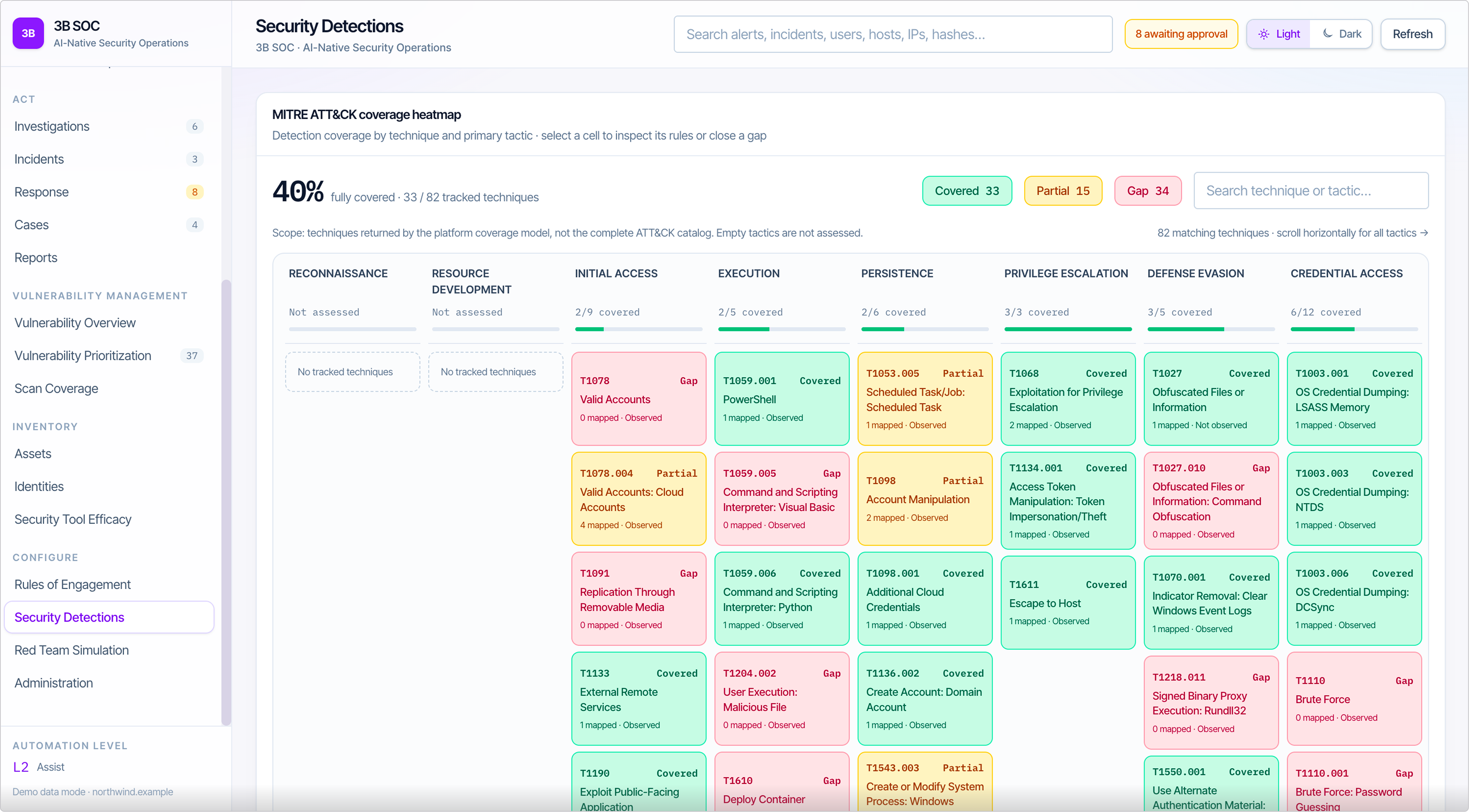
Managing detections can be tough. But this capability provides a centralized hub for managing your organization's security rules while visualizing your defensive posture. It combines a Detection Library; which tracks the status, language (e.g., KQL, SPL), volume, and performance (True Positive/False Positive ratios) of active threat detections with an interactive ATT&CK Coverage map. This side-by-side view allows security teams to seamlessly align their deployed rules with the MITRE ATT&CK framework, instantly identifying protected vectors and highlighting critical coverage gaps (categorized by covered, pending, and missing techniques).
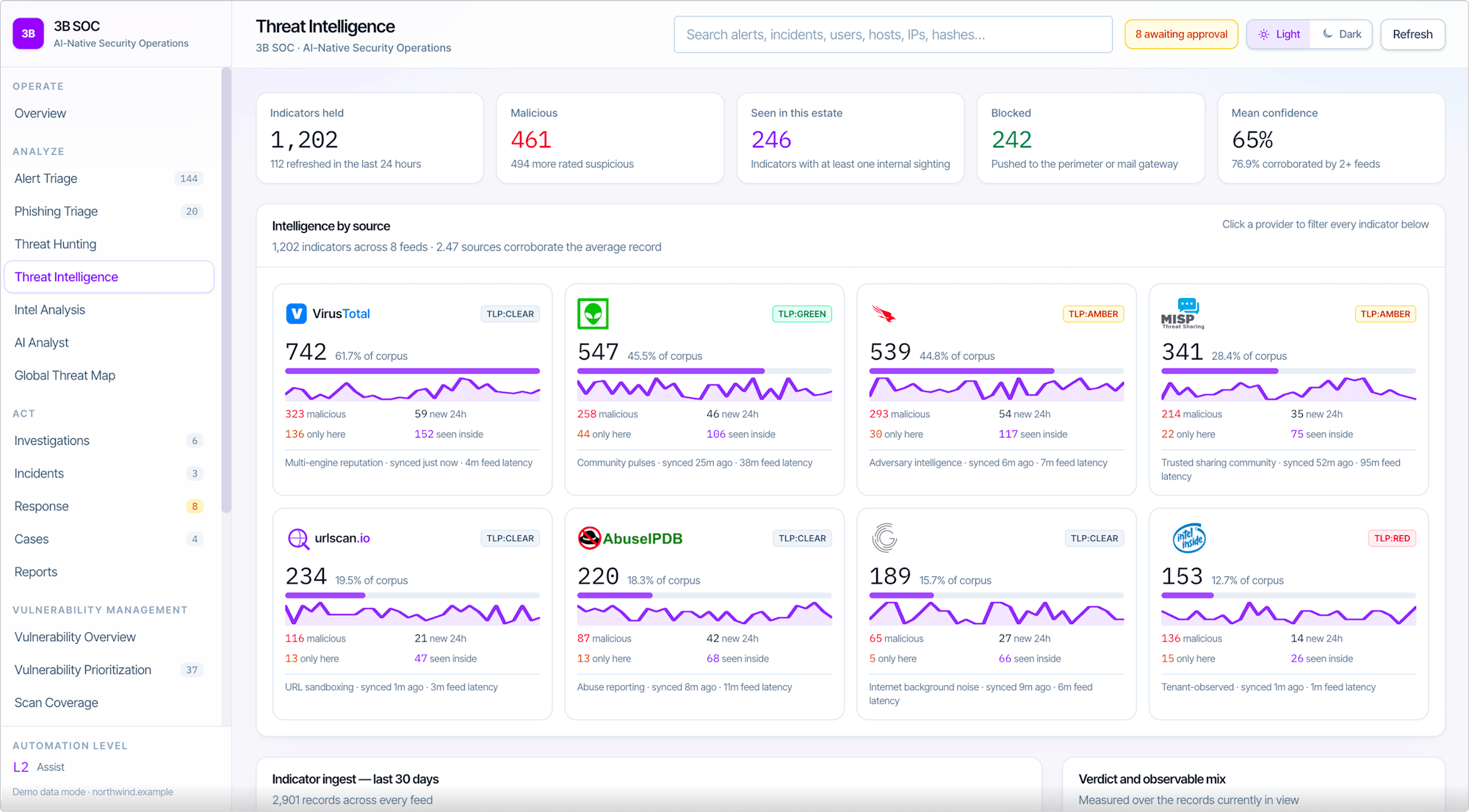
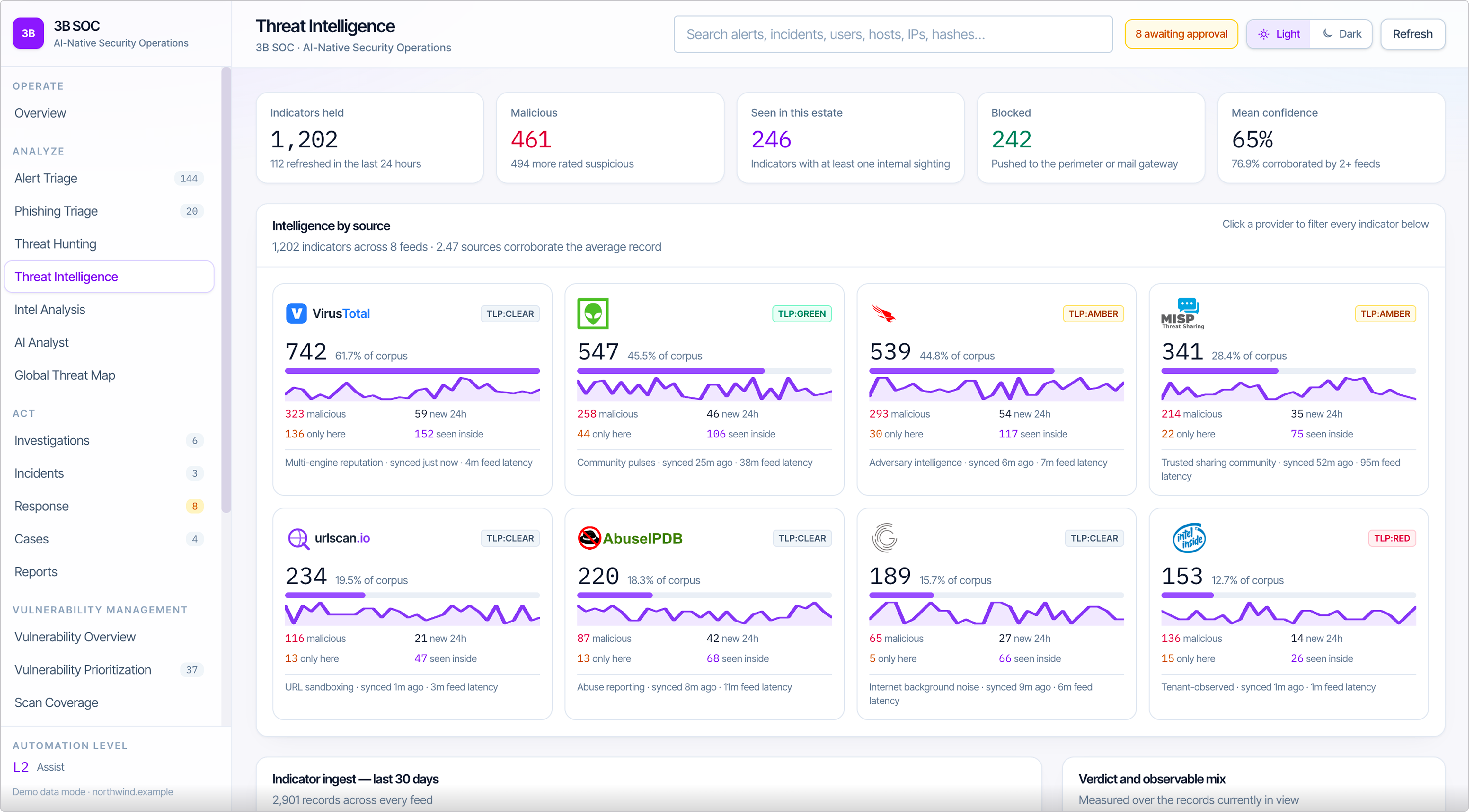
For my threat intelligence enthusiasts, this capability transforms your indicator lifecycle from static lists to active defense by bridging the gap between raw intel and live monitoring:
Automated ingestion: Directly integrate with your favorite TIPs, ISACs, or open-source feeds (via STIX/TAXII, MISP, etc.) to aggregate raw Indicators of Compromise (IoCs) into a single, unified pipeline.
Granular categorization: Enrich and organize your imported intel by threat actor, malware family, or MITRE ATT&CK technique. Apply custom tags for confidence scoring and expiration (TTL) to keep your data high-fidelity.
Frictionless deployment: Push curated intelligence directly into your detection pipeline. The system automatically maps and converts your categorized indicators into active alert rules (like KQL, SPL, or EQL) for your SIEM or EDR.
Ultimately, I realized a crucial visual component was absent from my incident investigation process. I wanted the ability to chronologically replay the attack execution and map the adversary's lateral movement throughout the environment.
This granular context is indispensable during digital forensics. Using a single prompt, I requested this functionality, and it was engineered in under three minutes. The result seamlessly integrated a button within the alert to visualize the Attack Map and sequentially replay the intrusion. Truly remarkable. A capability like this would have saved me, on average, six to 12+ hours of analysis time across the hundreds of incident response engagements I’ve conducted.
To truly take your AI SOC to the next level, you have to solve the actual bottleneck of incident response: safely gathering context across disparate internal systems and learning from past attacks.
Forward-thinking security engineering teams are already demonstrating that deploying effective AI agents requires strict, tool-layer security controls to prevent ungoverned access.
It’s no longer enough to have an LLM passively summarize an alert.
The next frontier is equipping your agents to independently interrogate APIs, query databases, and fetch live telemetry to perform deep triage. Crucially, it also requires embedding Retrieval-Augmented Generation (RAG) to give your agents a persistent memory. By grounding the AI in your historical incident data, custom runbooks, and previous analyst decisions, your autonomous SOC continuously learns and adapts to your specific environment; all without ever handing it the keys to the kingdom.
This is where integrating the Model Context Protocol (MCP) with Tines 3B becomes a massive differentiator. Rather than writing hardcoded integrations, you can use Tines 3B to construct custom MCP servers directly within your environment. When your AI SOC agent needs to gather context on a high-fidelity alert, it calls these specialized Tines workflows as standardized tools.
Because every action executes within a strict, sandboxed environment, your autonomous agents never directly hold underlying API keys or sensitive infrastructure credentials. You achieve the velocity of autonomous, contextual triage while maintaining absolute deterministic control, governance, and auditability over every action the AI takes.
Stop buying, start building
The era of buying rigid, black-box AI SOCs is ending, but the era of the agentic, custom-built security platform is just beginning. As my 23-minute build demonstrates, what used to require months of heavy engineering, complex integrations, and vendor lock-in can now be spun up seamlessly with Tines 3B.
By giving you the foundational building blocks to integrate your raw threat intel, map your detections to MITRE, visualize blast radiuses, and execute plain-English threat hunts, Tines isn't just selling another generic copilot.
It’s handing you the keys to orchestrate the exact SOC your unique environment demands, governed at machine speed.
Curious what this looks like in practice? I've published a working example of my AI SOC — complete with mock data, seeded alerts, and a red-team simulation — in the Tines 3B examples gallery. Import it to your Tines 3B tenant (available for free with our Explore Edition), click around, and see the alert triage, blast radius mapping, and threat hunting capabilities in action for yourself.
Building an AI SOC that fits your environment will always require your own context — vendor integrations, internal processes, and the specific tools your team already relies on. But this example gives you a real, explorable starting point.
The out-of-the-box AI SOC might be commoditized, but your security operations doesn’t have to be. It’s time to stop adapting your workflows to fit generic tools and start building the future of your defense.