
AI agents are showing up across every team's stack faster than the systems to coordinate them. Cross-team work that depends on five tools and three approvals tends to break in the handoffs between them, and most teams patch those breaks with manual stitching, fragile scripts, or alerts that age in a queue until someone notices.
Workflow orchestration is the coordination layer that closes those gaps. It sequences work across applications, AI agents, and humans, managing dependencies, state, and ownership so cross-system processes run reliably and stay auditable. As AI deployments accelerate, that layer becomes the control plane for how machines, humans, and tools work together.
This article covers business and security workflow orchestration, the kind that coordinates work across IT, security, HR, and operations teams.
What is workflow orchestration?
Workflow orchestration is the practice of coordinating multiple automated tasks, human decisions, and AI-driven actions across business applications and services so they execute in the right sequence, with the right dependencies, and with a complete record of what happened.
According to Tines' Voice of Security 2026 research, security professionals spend 44% of their time on manual, repetitive work, and 76% report burnout. That's the cost of the missing coordination layer.
Modern workflows aren't linear chains of API calls. They're branching, conditional processes where a machine enriches the data, an AI agent reasons through ambiguity, and a human makes the final call.
Why workflow orchestration matters in an AI and multi-agent world
Per Tines' Voice of Security (2026) report, 99% of Security Operations Centers (SOCs) use AI in some capacity. In a 2025 Forrester Consulting study commissioned by Tines, 88% of IT and security decision-makers said that without orchestration, AI stays fragmented, and 73% said they need end-to-end visibility into AI initiatives.
The dominant failure mode in production multi-agent deployments isn't model quality. It's absent coordination architecture between agents. Gaps in handoff, state, and ownership compound across calls. Gartner predicted that by 2030, half of all AI agent deployment failures will stem from governance gaps and broken interoperability between systems.
The security consequences are already documented. The OWASP Top 10 for Agentic Applications 2026 now lists Agent Goal Hijack, Tool Misuse, Identity and Privilege Abuse, and Cascading Failures as risk categories. The same governance concern surfaces in the Forrester Consulting study commissioned by Tines, where 54% said AI governance, privacy, and regulations are the top priority.
Tines' Voice of Security 2026 research also found that 66% of teams with a formalized AI policy are very optimistic about AI's impact. Orchestration is the control plane that keeps humans accountable while machines do more, not as a back-office exercise, but as the operating discipline that allows organizations to scale AI with confidence and trust.
Workflow orchestration vs. workflow automation
Orchestration includes automation, but automation alone doesn't get you orchestration. Automation is the execution of individual tasks by software. Orchestration is the coordination framework that manages handoffs between those automated tasks, human actors, and systems across an end-to-end process.
Put another way, automation handles the tasks, and orchestration handles the work. A script that pulls a hash reputation from VirusTotal is automation.
The end-to-end phishing investigation that fans out enrichment, routes by severity, pauses for human approval on containment, and logs every step is orchestration.
How workflow orchestration works
An orchestration layer has three things to get right. The components of the engine itself, the styles of work it can execute, and the way a workflow runs end-to-end. The next three sections cover each in order.
Components of a modern orchestration layer
A modern orchestration engine has six core components, each one solving a problem that breaks workflows when it's handled poorly.
Event handling: Workflows begin when something happens: a webhook fires from a Security Information and Event Management (SIEM) platform, a scheduled poll finds new alerts, or an employee submits a request. The orchestration engine handles event deduplication, routing by alert type or severity, and trigger conditions that determine whether a workflow should fire at all.
Dependency management: Real-world workflows aren't linear. A phishing investigation might fan out four enrichment requests in parallel, wait for all four to complete, then branch based on the combined results. The engine manages sequential dependencies, parallel fan-out, join conditions, and conditional branching.
Human approval gates: The orchestration engine must maintain a durable pause state, meaning the workflow instance persists indefinitely without timing out or losing context, whether the approver responds in seconds or hours. This architectural requirement separates orchestration platforms from simple automation chains.
Observability and audit trails: Live workflow state inspection, full execution history with inputs and outputs at each transition, and failure visibility with exact error type and retry count. Every workflow should be observable, the platform should log every execution, and every decision path should stay traceable, produced as a byproduct of execution rather than as separate instrumentation.
Policy enforcement: Policy operates at two levels. Workflow-level policy controls which workflows can execute, while action-level policy restricts what individual steps are permitted to do.
Retries and error handling: The engine must distinguish transient failures, an API rate limit that resolves with backoff, from terminal failures, an authentication error that won't fix itself. Mature orchestration layers implement exponential backoff with configurable retry policies and explicit classification of retryable vs. non-retryable errors.
The components work together so a workflow can run reliably across systems, pause for humans where it should, recover from failures, and leave a record.
Platforms that ship some but not all of these components push the missing logic into custom code, which is where coordination starts to break.
Three workflow styles, one orchestration layer
Real processes don't pick one style of execution. A phishing investigation has rule-based steps, judgment-driven steps, and AI-reasoning steps inside the same flow. The platform needs to handle all three without forcing a context switch.
Deterministic automation follows fixed rules: if X happens, do Y. Every step, branch, and outcome is specified before execution begins.
Agentic AI execution uses reasoning to determine the next action based on current context, rather than traversing a predefined graph. This is the right approach for novel threat types with no existing playbook and complex investigations requiring contextual reasoning across multiple data sources. The non-negotiable requirements are transparency into the AI's reasoning, guardrails restricting high-risk actions, and human-in-the-loop checkpoints for sensitive remediations.
Human-in-the-loop execution pauses workflows at defined checkpoints for human decision or approval. This isn't binary. It's threshold-driven. Configurable confidence levels govern when agents act autonomously and when humans step in. Destructive or irreversible actions, actions affecting privileged accounts, and regulatory requirements mandating documented sign-off all warrant human checkpoints.
These three styles are composable within a single workflow. A phishing investigation might use deterministic automation for alert ingestion, agentic AI for contextual investigation across SIEM history and HR data, a confidence-threshold gate that routes to a human if the verdict is uncertain, and deterministic containment and documentation for compliance.
This is the full-spectrum execution model: deterministic, human-led, and agentic workflows composable on one surface, within one Story (Tines' term for a workflow), governed by one control layer.
A typical orchestrated workflow
A walkthrough makes the mechanics easier to picture. Take a phishing alert from detection through containment.
The endpoint detection and response (EDR) console detects a suspicious attachment and sends a webhook; the engine deduplicates against existing alerts.
The workflow fans out concurrent enrichment requests to URL reputation, sender reputation, user risk score, and email metadata services.
An AI agent cross-references enrichment results with SIEM history, checks whether the user has been phished before, and generates a verdict with a confidence score and recommended action.
If the confidence score is high, automated containment proceeds; otherwise, the case routes to a security engineer with full context attached.
If the recommended action includes account lockout, the workflow pauses for human approval via Slack.
Upon approval, remediation is executed, and a case is created with the full investigation timeline, enrichment data, and approval record.
Every step gets logged, every decision stays traceable, and every action is reversible if needed. That's the floor for an orchestrated workflow, not the ceiling.
Examples of orchestrated workflows
Three patterns show up over and over when teams build orchestrated workflows: incident response, customer-facing escalation, and AI agent governance.
The shape stays consistent across all three (context collection, decision, action, documentation), and what changes is the system, the urgency, and the stakes.
1. Security incident response
In security operations, orchestration matters because the hard part is rarely one API call. It's the sequence of collecting context, correlating signals, deciding whether confidence is high enough to act, and preserving a case record.
At Netskope, putting that coordination into the SOC's operating flow helped the team triple efficiency without adding headcount and contributed to a 25% reduction in mean time to respond (MTTR).
2. Customer-facing escalation
Customer-facing escalation follows the same pattern even when the tools change. An incoming request needs classification, context enrichment, routing, and often a human review before the final action goes out.
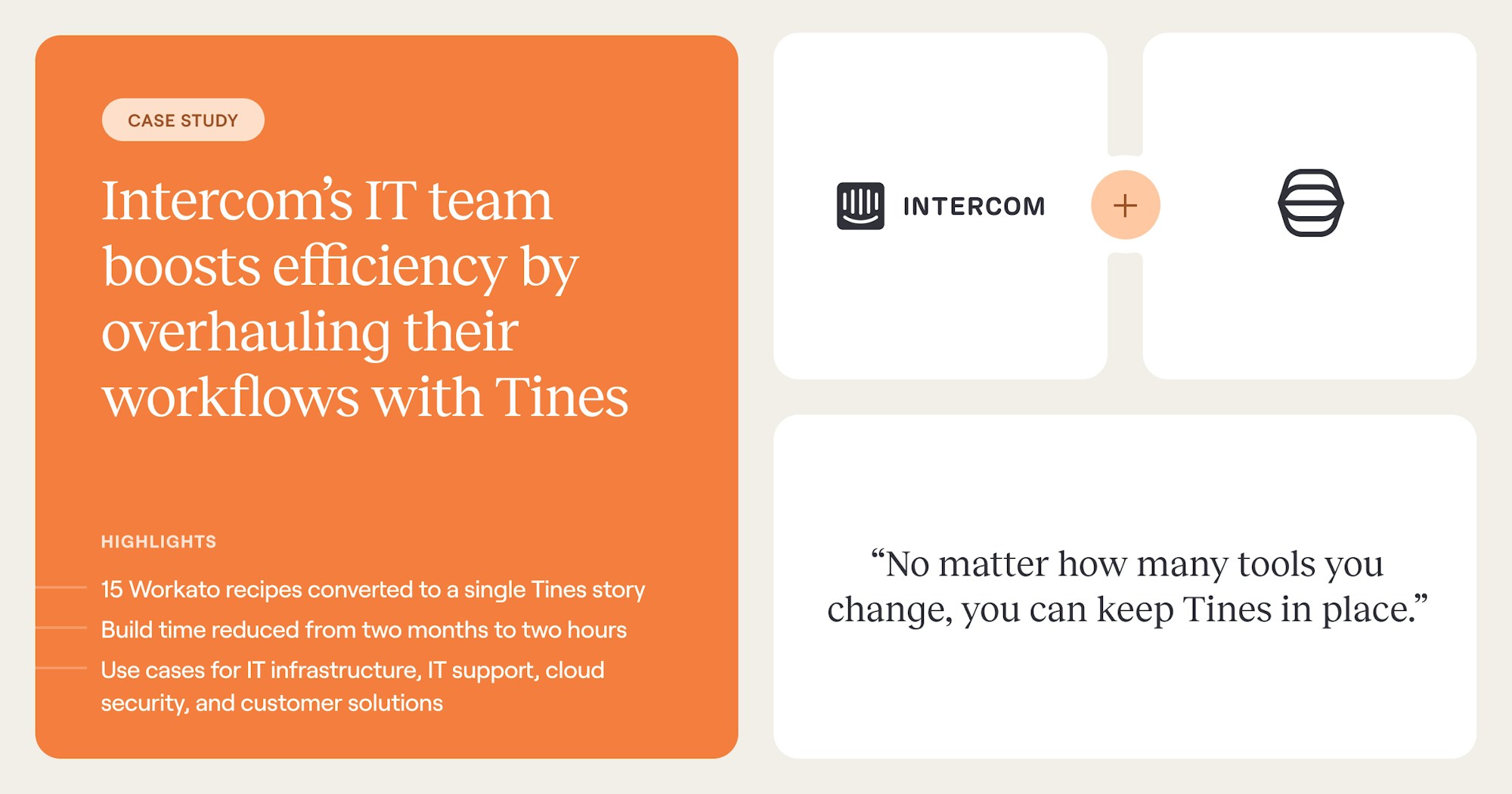
At Intercom, the IT team replaced Workato with Tines and consolidated 15 separate workflows into a single Story, dropping build time from two months to two hours.
The team built a hardware issue reporting flow where employees scan a QR code, the workflow opens an Intercom conversation, and remediation runs automatically, eliminating manual handoffs across IT support, infrastructure, and security.
3. AI agent governance
AI agent governance is the same orchestration problem in a higher-risk setting. Deterministic rules enforce policy boundaries, the AI Action operates within guardrails, and human-in-the-loop checkpoints gate sensitive actions.
At Vimeo, the security and Identity and Access Management (IAM) teams used Tines plus Gemini AI to correct over 2,000 historical Jira tickets, ran daily UKG-to-Okta identity reconciliation that saved 20+ hours per month, and connected 30+ applications to Lumos through Tines without native integrations.
The requirement extends beyond execution. Agents need traceability, approvals, and clear ownership when they act across system boundaries.
What ties these examples together is the structure. Each one runs across multiple systems, branches based on context, pauses for human judgment when stakes are high, and produces an audit trail by default.
That's the work an orchestration layer does, whether the trigger is a phishing alert, a customer hardware request, or an AI agent's access query.
Choosing a workflow orchestration platform
A workflow orchestration platform is worth picking carefully because it sits at the center of how teams get work done. The platform should support deterministic, agentic, and human-in-the-loop execution within a single workflow, because real processes mix all three.
Governance and audit logging belong in the core data model from day one, with per-agent permission controls, configurable approval gates, and compliance certifications like SOC 2 and ISO 27001 as table stakes.
The connector model needs to be vendor-agnostic so a tool change doesn't force a rebuild, and the platform should be usable by the people closest to the work, so workflows ship in hours rather than months.
The best way to test these claims is to ask the vendor to build a workflow during the evaluation. The workflow should span at least three systems, include a conditional branch, require a human approval step, and generate an exportable audit log.
If they can't complete that without professional services, the elapsed time is your real time-to-first-workflow. The same test reveals whether security and IT can operate on the same platform.
Tines is the intelligent workflow platform built for this work. The AI Action runs alongside deterministic steps and human-led approvals on one surface, with multiple AI providers and the Model Context Protocol (MCP) for agent interoperability.
The HTTP/API model connects to any system with an API, and Story Copilot on the Storyboard (Tines' visual builder) lets teams describe what they want to build in natural language and get functional Story components or full workflows they can customize immediately.
If you're evaluating workflow orchestration platforms, book a Tines demo to see deterministic, agentic, and human-led workflows running on one surface under a single governance framework.
Frequently asked questions about workflow orchestration
What's the difference between workflow orchestration and workflow automation?
Automation executes individual tasks by software. Orchestration is the coordination framework that manages handoffs between those tasks, human actors, AI agents, and systems across an end-to-end process.
You need automation inside orchestration, but automation without orchestration produces disconnected tasks with no visibility, no state management, and no audit trail.
How does workflow orchestration relate to BPM?
Business Process Management (BPM) is generally associated with structured, human-centric processes and process governance.
Workflow orchestration focuses on coordinating automated, cross-system workflows at scale, often in event-driven environments that also involve AI agents. Gartner's BOAT category is converging them, but buyer profiles and evaluation criteria remain distinct.
How do you orchestrate AI agents at scale?
AI agents that make frequent access requests, adapt queries based on intermediate results, and operate across system boundaries need a coordination architecture that traditional static role-based access models weren't designed to govern.
For example, on Tines, AI agents operate within Stories alongside deterministic and human-led steps, under the same governance framework, so every reasoning step, action, and approval stays auditable.
What is an orchestration engine?
An orchestration engine is the runtime that executes workflows across applications, AI agents, and humans. It handles event triggers, dependency resolution, durable state, retries, human approval pauses, and audit logging in one layer.
Without an engine, those concerns scatter across custom scripts, cron jobs, and tribal knowledge. With one, every workflow runs with consistent behavior, recovery, and visibility.
How does workflow orchestration work in security?
In security, orchestration pulls alerts from detection tools, enriches them with reputation and identity context, applies AI reasoning when the case is ambiguous, and pauses for human approval on destructive actions like account lockout or token revocation. Every step gets logged, and every decision traces back to its inputs.
What is the difference between orchestration and iPaaS?
Integration platform as a service (iPaaS) tools like MuleSoft and Boomi move data between systems. Workflow orchestration coordinates work across those systems, including human decisions and AI agents, with state, dependencies, and audit baked into the runtime.
iPaaS connects applications. Orchestration runs the end-to-end process those applications participate in.
How do you govern AI agents?
AI agent governance starts with clear scope, named ownership, and policy-as-code limits on what each agent can call or change. Pair that with audit logging on every reasoning step and human-in-the-loop checkpoints for high-impact actions.
On Tines, AI agents operate inside Stories alongside deterministic and human-led steps, under one governance framework, so every action an agent takes stays observable and reversible.