
Compliance teams know the pattern well: tracking down a missing access review sign-off at 11 p.m. the night before an audit, piecing together evidence from spreadsheets, email threads, and the gap between HR and IT. Access reviews keep appearing in SOC 2 exceptions, and the controls usually aren't the problem. The manual processes around them are.
Many teams respond by buying a dedicated GRC (Governance, Risk, and Compliance) platform. Traditional GRC tools are structured repositories. The underlying manual processes remain intact, and separate evidence collection leaves gaps.
Across frameworks, the same failure pattern appears. Audits often focus on clear proof of who has access, why they have it, and when it was last reviewed, alongside strict expectations for evidence and documentation. The sections that follow show how automated workflows close these gaps framework by framework, starting with what compliance workflow automation actually is.
What is compliance workflow automation?
Compliance workflow automation encodes compliance controls as live, integrated workflows. Instead of teams collecting evidence manually after the fact, the workflows themselves generate audit evidence as a byproduct of normal operation.
The real difference lies in when evidence is created and who (or what) creates it. In a manual model, every handoff introduces delay and the possibility that a step gets skipped. In an automated model, the workflow polls identity providers on a scheduled cadence, distributes certifications to system owners inside the platform, records decisions with timestamps, executes deprovisioning for revoked access, and pushes the complete evidence package to the compliance system.
This approach treats compliance automation as closely related to the broader workflow practices security teams use across operational processes. Encoding controls as reusable, auditable workflows with built-in governance turns compliance from a periodic scramble into a continuous, system-owned function.
The specific failure patterns these workflows address, and the audit findings they generate when left manual, follow a predictable structure across SOC 2, GDPR, and ISO 27001.
Why manual compliance breaks SOC 2, GDPR, and ISO audits
Manual compliance fails because it separates the act of controlling from the act of documenting. Auditors across all three frameworks test for the same thing: proof that controls operated continuously, not just that policies existed. As many practitioners have put it, compliance is a great starting point for security, but the gap between the two usually shows up first in the evidence.
Each framework exposes that gap differently. SOC 2 surfaces it through repeated exception categories, GDPR through deadlines that manual handoffs cannot meet, and ISO 27001 through evidence requirements that spreadsheets quietly fail. The three sections that follow break down each failure mode in turn.
1. SOC 2 Type II: manual process failures dominate exceptions
The CBIZ 2024 SOC Benchmark Study highlights key challenges and reporting benchmarks in SOC programs. Common exception categories discussed in SOC and compliance contexts include business approvals and reviews, user access reviews, terminations, and change management.
These controls fail most often because they rely on humans to remember to document what they did, when they did it, and who approved it. In practice, audit pain often comes less from missing security controls than from broken processes around evidence and execution.
2. GDPR: statutory deadlines that manual processes miss
GDPR enforcement does not operate on fixed statutory deadlines. The CMS GDPR Enforcement Tracker report uses a cut-off date of 1 March 2025, and the GDPR Enforcement Tracker records 2,245 fines (or 2,560 including fines with limited information), amounting to around €5.65 billion in total fines since GDPR took effect.
Manual breach response depends on human escalation chains and ad hoc documentation, both structurally mismatched to a narrow notification window.
3. ISO 27001: the negative evidence trap
ISO 27001:2022 certification audits often catch manual processes by requiring a capability that many spreadsheet-based systems struggle to satisfy: evidence that checks were performed even when no changes were found. Incomplete risk assessments and weak documentation also recur in audit findings.
These deficiencies cascade through monitoring, management review, and continuous improvement clauses, all tracing back to manual processes without durable, timestamped evidence. The process-layer fixes for each of these failure modes follow next, with integration patterns specific to each framework.
What makes a compliance workflow auditable by design
A compliance workflow is auditable by design when audit evidence is a property of the workflow's architecture and a direct output of the workflow itself. Two design principles anchor this approach:
Immutable, append-only logging with cryptographic integrity: Recorded events cannot be edited. Each log entry is cryptographically linked to the previous one, creating a tamper-evident chain where any alteration flags the entire log. A complete entry captures four elements: the event, the triggering command or intention, user identity at the time of action, and permissions at the time of action. Access to log archives must also be logged, and delete access should be architecturally absent from all roles, including administrators.
Evidence generated at control execution, mapped across frameworks: Evidence collection should be a byproduct of the automated workflow, not a separate task. When a CI/CD (Continuous Integration/Continuous Deployment) pipeline enforces approval gates, its configuration and execution logs are the evidentiary artifacts. No separate spreadsheet required. A single automated access review workflow can serve multiple frameworks if evidence is tagged to each framework's control identifier at collection.
These design principles translate into concrete, framework-specific workflows with defined triggers, integration points, and evidence outputs.
Compliance workflows by framework
Each framework has specific controls where automated workflows replace the manual processes most likely to generate findings. The three sections that follow walk through the highest-impact workflows for SOC 2, GDPR, and ISO 27001.
SOC 2: access reviews and change management
User access reviews and change management both map to workflows that can run with minimal human involvement, aside from the approval step itself. For the access review workflow covering CC6.1, CC6.2, and CC6.3, an HRIS event, such as a role change or termination, in BambooHR triggers a webhook. This is the same pattern that mature identity and access management programs rely on to keep entitlements clean across hundreds of applications.
The workflow queries Okta for the user's current entitlements, distributes certification requests to system owners inside an auditable platform (not Slack or email), executes deprovisioning for revoked access with timestamped records, and pushes the complete certification package to Drata or Vanta mapped to CC6 controls. Evidence artifacts: timestamped certification reports with manager sign-offs, deprovisioning logs, and entitlement snapshots before and after the review.
The same pattern applies to change management (CC8.1), where pull request merges in GitHub trigger automated evidence collection through policy-as-code gates and linked Jira tickets. Teams that have stitched these patterns together often find their SOC 2 audit prep compresses dramatically, because the evidence is already assembled by the time the auditor asks for it.
GDPR: breach notification and DSAR fulfillment
For breach notification workflow, an alert from the SIEM or EDR (Endpoint Detection and Response) fires a webhook. The workflow creates a dedicated incident channel, auto-creates a Jira ticket with organizational context, and tracks the 72-hour notification deadline with auto-escalation.
In a well-designed automated workflow, a webhook trigger receives the SIEM or EDR alert and downstream actions create the incident channel and Jira ticket. A separate step calculates the 72-hour deadline, and conditional logic triggers escalation if the deadline approaches without resolution.
System-generated logs tend to carry more weight with auditors because systems cannot forget or rewrite history. DSAR fulfillment applies the same pattern with jurisdiction-specific deadline calculation, cross-system data discovery, and immutable audit trails from intake through delivery.
ISO 27001: continuous monitoring and risk assessment
For continuous control monitoring workflow, AWS Config continuously monitors cloud configuration. When it detects drift (S3 bucket encryption is disabled, a security group is modified, or an IAM policy is changed), the event fires a webhook.
The workflow creates a remediation ticket with suggested fixes and assigned responsibility, feeds the finding into the risk assessment cycle, and retains the complete alert-to-remediation audit trail. A webhook trigger receives AWS Config drift events; downstream actions create remediation tickets and update the risk register; and a transform step assembles the audit trail with framework control tags.
Automated risk registers can be built on Tines Records for structured workflow state and reference data, combined with a built-in ticketing and incident-management surface, mapped to ISO 27001 ISMS and NIST SP800-30.
These workflows produce the evidence. The next section focuses on whether auditors will accept it.
How to build compliance workflows your auditors will trust
Auditors need automation they can verify. In practice, auditors first ask how to confirm the workflow did what you say it did. The steps below outline how to design, document, and consolidate workflows so they withstand audit scrutiny.
Step 1: Test the automated control, not the legacy process
Industry guidance from major audit firms emphasizes segregation of duties and the documentation of internal control deficiencies. Focus testing on what actually enforces the control today, not on the manual process it replaced.
Identify the operative mechanism. For each control, document whether the automated component is the operative enforcement mechanism so that auditors test the correct artifact.
Align to the review window. SOC 2 Type II engagements typically cover a defined review period of about 6 to 12 months. Auditors may sample from populations covering that period, so keep evidence available throughout.
Collect the right artifacts. Required artifacts include API-exported identity provider logs, ticketing system exports with approver names and timestamps, and vulnerability scan results with open and closed dates per finding.
These checks shift the audit conversation from "did someone do this?" to "here is the system that did it, and here is the record it produced."
Step 2: Validate the automation tool itself
Industry guidance on compliance programs frequently points to recognized standards such as ISO 27001 and notes that organizations may need to provide SOC 2 reports or other evidence based on client or business requirements. Before relying on a tool to enforce a control, confirm it can be audited in its own right.
Check access controls. Confirm the tool enforces role-based access and least privilege on the workflows themselves.
Review the change log. Look for a complete, tamper-evident record of configuration changes to every workflow.
Verify compliance certifications. Confirm the tool carries its own SOC 2, ISO 27001, or equivalent attestations relevant to your program.
Test output verifiability. Make sure workflow outputs can be independently reconciled against the source systems they pull from.
Step 3: Document each evidence artifact
Each automated evidence artifact should stand on its own when handed to an auditor. Capture the metadata that makes the artifact self-explanatory: which control it satisfies, mapped to the specific framework identifier, and the time period covered by the artifact.
Also record the source system the data was pulled from and the collection method, including the workflow, query, or API call that produced it. Sound compliance practice maps policy requirements to controls and controls to workflows to help demonstrate a complete and well-designed control structure.
Step 4: Consolidate workflows to reduce audit scope
Governed workflow consolidation also reduces audit scope and change-control ambiguity. One operative workflow with visible approvals and change history is easier to test, easier to explain, and harder to let drift than a patchwork of bots, point tools, and undocumented handoffs.
In practice, that means replacing duplicates with a single canonical workflow for each control objective, centralizing approvals and change history so reviewers can trace decisions in one place, locking production workflows to read-only so that any modification requires review and approval, and capturing all governance operations in tenant-level audit logs that auditors can sample directly.
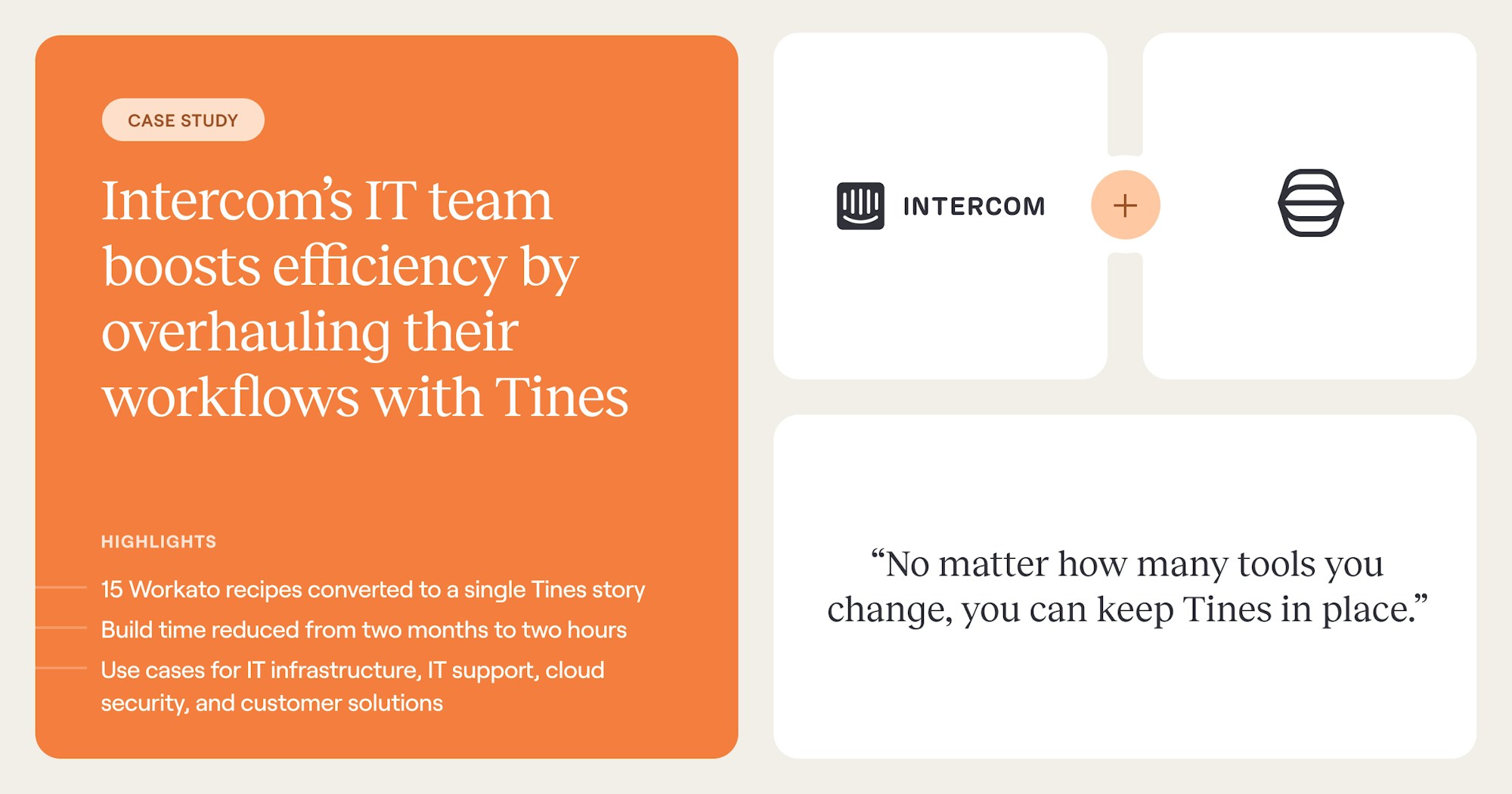
At Intercom, the IT team reduced build time from 2 months to 2 hours and consolidated 15 separate workflows into a single Story.
Building compliance that survives the next audit
Compliance fails when teams treat it as a periodic project rather than an architectural property. Organizations that still rely on annual evidence-collection fire drills may face avoidable control challenges.
Through Tines, compliance and IT teams build workflows with governance, audit trails, and AI guardrails in every layer on a platform that is itself auditable. No separate evidence collection step. The same platform supports deterministic workflows for scheduled access reviews, agentic AI for risk scoring and evidence triage, and human-in-the-loop approvals for sensitive certifications under the same security controls.
For teams moving compliance work out of spreadsheets, inboxes, and one-off scripts, Community Edition, Tines' free tier (forever free, with AI, SSO, and unlimited integrations), offers a practical place to start. Book a demo to see how Tines can make your compliance program auditable by design.
Frequently asked questions about Compliance workflow automation
How do you automate SOC 2 access reviews?
An HRIS trigger such as a role change or termination fires a webhook that queries the identity provider (Okta, Entra ID, or equivalent) for current entitlements and distributes certification requests to system owners inside an auditable platform. The workflow then executes deprovisioning for revoked access with timestamped records and pushes the certification package to Drata or Vanta mapped to CC6.1, CC6.2, and CC6.3.
What evidence does an automated workflow produce for ISO 27001?
It produces continuous, timestamped evidence that controls operated throughout the audit period: AWS Config drift events generate remediation tickets, risk register updates, and a complete alert-to-remediation audit trail tagged to ISO 27001 control identifiers. Risk registers built on Tines Records capture structured workflow state mapped to ISO 27001 ISMS clauses and NIST SP800-30, addressing the negative evidence trap by proving checks ran even when nothing changed.
How do you handle compliance automation for contractors and non-employees?
Contractors typically sit outside the primary HRIS, so workflows ingest events from contractor management systems, vendor portals, or a non-employee directory and apply the same access review, certification, and deprovisioning logic. Contract end dates become scheduled triggers for automatic deprovisioning, and evidence is tagged to the same SOC 2, ISO 27001, and GDPR control identifiers used for employees.
What's the difference between a GRC platform and compliance workflow automation?
Traditional GRC platforms are structured repositories for risk registers, policy documents, and uploaded evidence, while compliance workflow automation platforms orchestrate the process through live integrations. They pull evidence directly from source systems, continuously test controls, and trigger remediation when drift is detected. GRC platforms store evidence; compliance workflow automation generates it.
How does DORA affect compliance workflow automation for financial services?
The EU Digital Operational Resilience Act (DORA) requires financial entities to maintain continuous ICT risk monitoring, incident classification within strict reporting windows, and evidence of third-party risk oversight, which manual evidence collection cannot meet reliably. Automated workflows handle the incident classification, regulator notification timelines, and third-party monitoring evidence chains DORA assumes are in place, and the same pattern applies to NIS2 obligations across critical-infrastructure sectors.
How can one automated workflow satisfy multiple compliance frameworks?
A single automated access review workflow satisfies multiple frameworks when evidence is tagged to each framework's control identifier at collection time, for example mapping the same certification record to SOC 2 CC6.2, ISO 27001 A.5.18, and GDPR Article 32 in one pass. The same pattern applies to change management and incident response documentation.