
AI agents don't behave like the playbooks security and IT teams have spent years building. They form intent, select tools at runtime, and chain actions across systems in sequences nobody pre-authored. This means dropping an LLM into an existing automation sequence and expecting it to act like a smarter playbook is the fastest route to ungoverned, unpredictable outcomes.
For security leaders, this gap is more than a technical inconvenience. Boards are issuing two mandates at once: accelerate AI adoption and maintain airtight governance. Security, IT, and compliance teams are caught in the middle, expected to deploy autonomous agents across production systems without sacrificing the auditability, control, and human oversight their organizations depend on.
This article shows how an intelligent workflow platform closes that gap by unifying deterministic steps, agentic reasoning, and human checkpoints under a single governance layer.
What is agentic workflow automation?
Agentic workflow automation is an orchestration architecture that orchestrates multiple agents toward compound goals, with governance at every step. It's not a single chatbot or standalone agent, but the layer that coordinates them.
It combines three execution styles in one governed environment:
Deterministic workflows: follow fixed rules to handle predictable, auditable tasks at high volume.
Agentic workflows: reason through ambiguity, pull context from connected systems, and decide within team-defined controls.
Human-in-the-loop workflows: route to people at the moments where judgment, accountability, or irreversible consequences are in play.
None of these styles is sufficient on its own. The work of agentic workflow automation is in the orchestration layer underneath. It decides which style runs when and applies the same governance, auditability, and control standards across all three. Without that layer tying them together, AI deployments fragment into disconnected tools that are difficult to govern at scale.
Agentic workflows vs. AI agents vs. deterministic automation
The three categories are often used interchangeably in vendor pitches, but they describe fundamentally different things: a component, a rulebook, and an orchestration architecture. Getting the distinction right matters because the evaluation criteria, governance model, and failure modes differ.
Gartner warns about "agentwashing": calling an AI assistant that answers questions an "agent" to capture budget allocated for something fundamentally different. A chatbot with an API key is not an agentic platform, and a SOAR playbook with an LLM call bolted on is not agentic workflow automation.
Here's how the three actually differ:
A few implications follow directly from this comparison:
Deterministic automation isn't going away: Legacy SOAR platforms are predictable and auditable, but brittle: when threats deviate from the authored pattern, the playbook stalls. Plus, legacy SOAR often came with its own overhead like engineering-intensive setups, brittle playbooks, and limited adaptability. The predictable work it handles is still real work; it just shouldn't be the only thing the platform can do.
A standalone agent is a component, not a system: Drop it into production without state management, credential scoping, audit trails, and human checkpoints around it, and you've shipped a reasoning engine with production access and no guardrails.
Agentic workflow automation ties the two together: It coordinates specialized agents, manages state across steps, enforces governance checkpoints, runs deterministic steps for predictable work, and escalates to humans where judgment matters. The platform governs both the predictable work and the scenarios the playbook was never designed for.
Mars, a Tines customer, shows this in practice. Mars consolidated 200 Phantom playbooks into 79 Tines Stories (Tines' name for automated workflows), migrated 100% off Splunk, and onboarded 5 teams in 6 months.
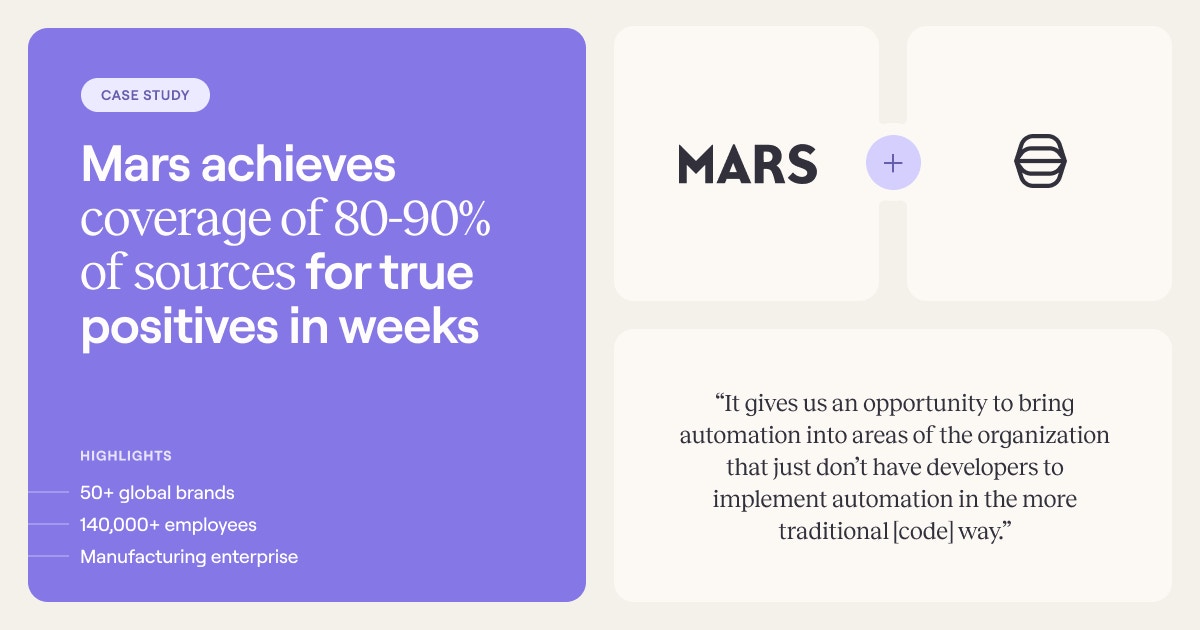
Deterministic steps still do the heavy lifting on known patterns, agentic reasoning fills the gaps, and all of it runs on one governed surface.
Components of an agentic workflow that runs in production
Production agentic workflows succeed or fail on four fundamentals: how they start work, hold state, recover from failure, and prove what they did.
The sections below cover each in turn: triggers and orchestration, state management and error handling, and observability beyond standard logging.
1. Triggers and orchestration
Production workflows fire from multiple entry points: a webhook that receives a CrowdStrike detection, a scheduled poll that checks an ITSM platform for unresolved tickets, or a threshold breach in a monitoring metric.
The orchestration layer coordinates what happens after the trigger, routing the event through deterministic enrichment steps, agentic reasoning, and human approval gates in whatever sequence the workflow requires.
The orchestration layer must decouple the agent's non-deterministic reasoning from the workflow's deterministic execution guarantees. The workflow ensures reliable execution of tools for non-deterministic agents, regardless of the agent's probabilistic reasoning path.
2. State management and error handling
If an agent fans out to process many items in parallel and a few fail halfway through, where does the workflow resume? Production state management needs persistent checkpointing so workflows recover from the last successful step, not from the beginning.
Agent-specific circuit breakers prevent runaway loops. Google's SRE guidance says that "any action performed by an agent must be highly interruptible," and that systems should implement agent-specific rate limits and automated circuit breakers to prevent runaway loops or excessive resource consumption.
3. Observability beyond standard logging
Standard application monitoring captures inputs and outputs but misses the intermediate reasoning that makes agent decisions auditable.
Production observability requires trace hierarchies that adhere to OpenTelemetry standards, with structured spans linking workflow invocations, individual steps, and tool calls into a reconstructable chain. Without this structure, investigating why an agent dismissed an alert or escalated a ticket becomes forensic guesswork.
The most efficient setup runs automated workflows and incident collaboration on the same surface, with audit logs built into every step. That keeps the governance layer aligned with deterministic execution and human checkpoints, instead of bolting on a separate observability stack to reconcile after the fact.
Governing AI agents inside workflows
Governance has to be built into the orchestration layer, not the agent's system prompt. The four controls below cover audit trails, credential scoping, tiered human approval, and output validation. They keep agents inside their intended scope once they're running in production.
Immutable audit trails with decision-chain traceability
Production AI audit trails must capture why a decision was made: intermediate reasoning steps, tool selections, and context sources consulted between input and output.
Guidance on AI logging says logs should capture prompts, outputs, model decisions, data flows, and records that let reviewers reconstruct what happened. All agent telemetry should flow into enterprise Security Information and Event Management (SIEM) platforms for correlation, with write-once, tamper-evident properties that make logs usable for compliance, not just debugging.
Least-privilege credential scoping with time-bound access
Agents operating under the standing, human-like credentials of their developers present a severe reliability risk. Production credential governance calls for distinct agent identities, on-demand access scoped per task, and least-privilege permissions.
Identity governance for agentic systems must account for identity provisioning, authentication, authorization, and credential management, especially when agents operate across multiple teams or contexts. Through Tines, teams manage credentials as a distinct part of the architecture, with Model Context Protocol servers and AI features built for secure, private use within Tines' infrastructure.
Human-in-the-loop approval gates
Uniform human-in-the-loop requirements create approval fatigue that degrades the value of automation. The production pattern tiers human involvement by risk level. Governance guidance for high-risk AI workflows commonly emphasizes human approval or verification, monitoring, and auditability. Lower-risk workflows need activity logging and role-based access controls at minimum.
McKesson's Active Defense team shows the operational impact of getting this balance right. The team freed 1.5 analysts per week from one early implementation by fully automating incident chat-room setup and routing suspicious-login verification to the affected user in their own language.
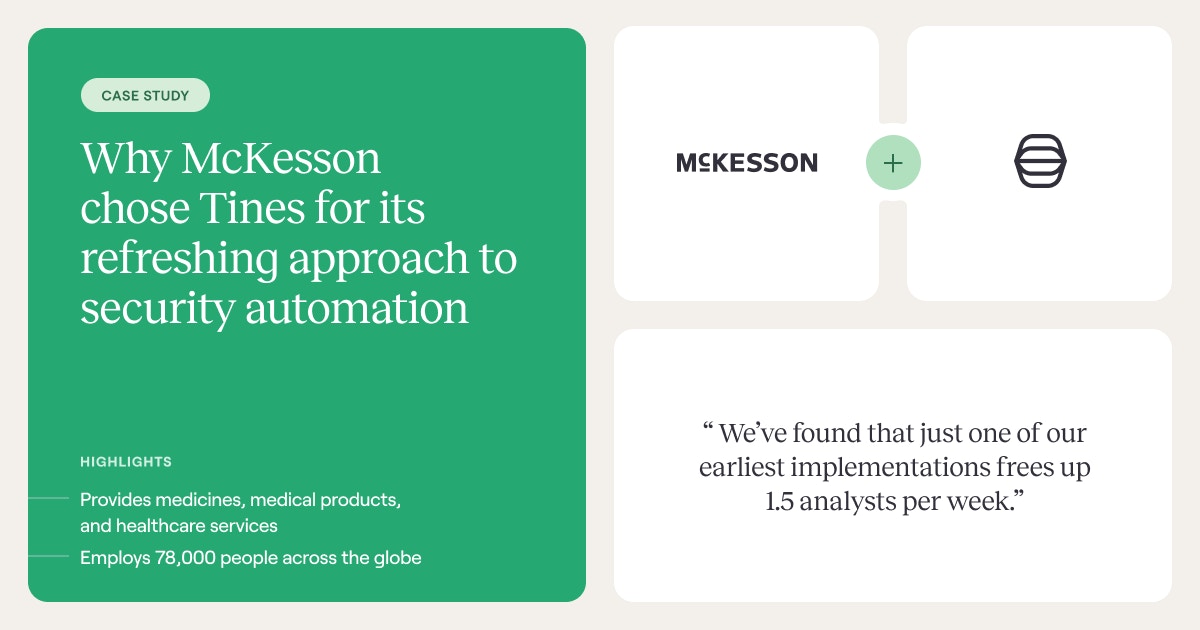
High-volume, low-risk checks run on their own; consequential actions still get a human in the loop, just without the manual setup cost.
Output validation and scope boundaries
OWASP LLM05:2025 identifies improper output handling as a top-ten risk. Validation logic must reside in the orchestration layer. Output validation must occur at each agent-to-agent boundary, since one agent cannot assume upstream output is safe.
Scope boundaries require technical enforcement, not documentation. OWASP guidance for LLM application risks emphasizes access control principles such as least privilege and role-based access control.
Where agentic workflow automation runs across the business
Agentic workflow automation shows up wherever work mixes high-volume structured tasks, context-dependent decisions, and human judgment on consequential actions. Three deployment patterns appear consistently across domains:
Collapsing alert-to-containment timelines: Security teams use a trigger-enrich-route sequence. An alert fires from a SIEM or EDR tool; deterministic steps enrich the Indicator of Compromise (IOC) against threat intelligence and internal asset data; an agent scores the alert and drafts a recommended action, and low-confidence results route to a human reviewer. Attacker breakout times are now measured in minutes, not hours, so manual triage workflows can't close the gap.
Automated ticket triage and resolution: IT teams deploy agentic workflows for ticket routing, incident remediation, and employee self-service. A service desk ticket lands in Jira or a ticketing system; an agent reads the body and requester profile, classifies severity, queries knowledge bases for matching resolutions, and either auto-resolves low-risk cases or escalates with a populated case for the support team.
Continuous compliance evidence collection: GRC teams use agents for continuous evidence collection rather than point-in-time audit prep. Agents run continuously against data sources, collect evidence, score control compliance against frameworks such as SOC 2, GDPR, and HIPAA, and generate audit-ready documentation as an ongoing output. The result is risk and control rationalization, issue clustering, and evidence capture across connected enterprise systems without the pre-audit scramble.
The cross-cutting pattern across all three domains is consistent: agents act autonomously on routine, structured, reversible tasks and pause for human approval before executing high-impact or irreversible actions.
Building agentic workflows on a governed foundation
Teams evaluating agentic workflow automation need to know whether the platform governing those agents treats governance as architecture or as an afterthought. The point is that existing security frameworks are not enough for systems that operate autonomously, chain actions across tools, and make decisions that are hard to audit or reverse. Controls have to be built into the orchestration layer.
Teams that need the full spectrum of execution build on platforms like Tines, an intelligent workflow platform designed for deterministic steps, agentic reasoning, and human checkpoints on the same surface. Immutable audit logs, secrets management, role-based access, and AI controls are built into the architecture rather than bolted on.
Agentic workflow automation is where the work is heading, but only for teams that govern it from the start. Book a demo to see it in action.
Frequently asked questions about agentic workflow automation
What makes agentic workflow automation different from a standalone AI agent?
A standalone AI agent handles one task type within a defined scope. Agentic workflow automation is the orchestration architecture that coordinates multiple specialized agents, manages state across steps, enforces governance checkpoints at each boundary, and runs deterministic and human-led steps alongside agents in a single governed workflow.
Can agentic workflows run alongside existing SOAR playbooks?
Yes. Most organizations layer agentic capabilities onto existing platforms as a first step rather than replacing their entire SOAR deployment overnight. Deterministic playbooks continue to handle the predictable, high-volume work they were designed for, while agentic steps handle novel scenarios where fixed logic breaks down.
How do teams prevent AI agents from exceeding their intended scope in production?
Security guidance for LLM applications often emphasizes least privilege and limiting agent scope to reduce risk. Scope boundaries must be technically enforced at the platform level through restricted tool access, time-bound credentials, and output validation at each agent-to-agent boundary.