
A new hire's first day reveals everything broken about how companies coordinate identity. The laptop is late, the Slack account exists, but Salesforce doesn't. Or the VPN cert is missing, and someone in IT is pinging three different system owners to figure out who provisions what. Multiply that by every joiner, mover, and leaver across every region, and the seams between HR, IT, and security start to show.
The deeper problem is that no single system owns the employee lifecycle end-to-end. The HRIS knows who someone is, the identity provider knows what they can sign in to, the MDM knows which device they hold, and the SaaS apps know what they can do within each tool. None of them talk to each other without help, and the help is usually a person.
This article walks through the eight intelligent workflows that close those seams, and how People teams put them into production.
TL;DR
HR workflow automation coordinates cross-system processes triggered by employee lifecycle events (hire, role change, termination) across identity providers, SaaS applications, security tooling, and IT operations.
The eight workflows every People team needs span identity reconciliation, global onboarding, access-verified offboarding, self-service access requests, long-tail SaaS provisioning, hardware fulfillment, security policy rollout, and emergency notifications.
AI supports these workflows through access recommendations, anomaly detection, and natural-language request handling. The EU AI Act classifies HR AI systems as high-risk, and only 36% of organizations have adopted a formal AI governance framework.
What HR workflow automation does
A hire can trigger account creation in the identity provider, provisioning across a dozen SaaS applications, hardware dispatch, training enrollment, and manager notifications. The discipline sits above the HRIS, identity provider, MDM, and SaaS layer, sequencing actions, enforcing approval logic, and producing an audit trail across every system involved. Orchestration platforms such as Tines operate at that layer, connecting the systems that own each part of the employee lifecycle.
Native HRIS (Human Resource Information System) automation (Workday, BambooHR, SAP SuccessFactors) handles HR-internal processes such as document collection and payroll triggers, and does not execute in identity providers, Active Directory, MDM, or SaaS applications. iPaaS (Integration Platform as a Service) moves data between systems and targets data exchange rather than human approval workflows or conditional process orchestration.
RPA (Robotic Process Automation) typically replicates mouse clicks and keystrokes at the UI layer and is prone to breaking when interfaces change. BPM (Business Process Management) platforms prioritize long-running governance analysis over the sub-second execution required by real-time deprovisioning.
When a termination event fires in the HRIS, security teams need immediate revocation across every connected system, and no single platform in the stack handles that coordination natively.
How modern HR workflow automation works
In many production deployments, teams treat the HRIS as the authoritative source for identity lifecycle events. Provisioning systems detect changes there and update the identity record accordingly.
Teams organize lifecycle events around the Joiner-Mover-Leaver (JML) framework:
Joiner: triggers account creation and provisioning of birthright access.
Mover: triggers simultaneous access grants and removals for the new and old roles.
Leaver: triggers access revocation, license reclamation, and account deactivation.
Two trigger patterns show up in production. In mature deployments, the HRIS record change directly fires downstream workflows through webhooks or scheduled API polling. A transitional pattern routes through ITSM (IT Service Management), where HR submits a service desk ticket that then triggers provisioning.
SCIM (System for Cross-domain Identity Management) handles the transport of identity data between identity providers and SaaS applications. But SCIM compliance doesn't guarantee interoperability. Vendors interpret PATCH handling, group membership behavior, and delete operations differently, and SCIM coverage rarely extends across the full application footprint. Legacy applications, AI tools, and apps lacking enterprise APIs often fall outside.
The layer above SCIM coordinates SCIM-connected apps, non-SCIM apps, hardware, training, and everything in between. Across the Tines customer base, the average customer connects 68 different tools through the platform.
The eight intelligent workflows every People team needs
Each workflow below crosses departmental boundaries and requires coordination between systems that don't share native integrations. Most teams build them in the order below, starting with the identity foundation and expanding outward.
1. HRIS-to-identity-provider reconciliation
Orphaned accounts, mismatched permissions, and audit findings usually start with drift between the HRIS and the identity provider (IDP). A reconciliation workflow compares active employee records in the HRIS against active accounts in the IDP on a scheduled cadence, surfacing mismatches the day they occur rather than during quarterly reviews.
Vimeo's identity team built exactly this pattern through Tines: a daily reconciliation story (Tines' term for workflows) that compares every active worker in UKG against every account in Okta. Scheduled HTTP Request Actions pull both datasets.
A Transform Action (manipulate, reshape, and enrich data between workflow steps without writing code) compares them, and any mismatches are routed to Cases (Tines' built-in ticketing and incident-management surface) or Slack for remediation.
Vimeo's IAM team saves 20+ hours per month on identity reconciliation and reclaimed 1,000+ hours clearing 2,000+ historical Jira vulnerability tickets. Pre-built versions of this pattern are available in the Library (Library, Tines' story Library of 16K+ pre-built workflow templates).
2. Global onboarding across time zones
A new hire in Singapore shouldn't wait for an IT engineer in Dublin to wake up. Global onboarding workflows fire automatically when a new-hire record appears in the HRIS, provisioning accounts across identity providers, productivity suites, collaboration tools, and role-specific applications based on department, title, and location attributes.
A pre-built workflow pattern in the Library identifies employees starting that day, then simultaneously provisions Okta, Slack, Google Workspace, and Microsoft Entra ID accounts. The workflow uses scheduled HTTP Request Actions to pull the BambooHR report and parallel HTTP Request Actions to provision each downstream system.
3. Offboarding with access verification
Termination triggers some of the highest-stakes actions in HR workflows. The window between a resignation letter and the complete removal of access is where the most damaging gaps appear, and most regulated industries treat prompt revocation across all connected systems as the baseline expectation.
Disabling the SSO account addresses one aspect of access revocation during offboarding. OAuth tokens, API keys, shadow SaaS accounts, AI agent permissions, and file ownership persist independently, and each one needs to be tracked down and severed before the offboarding is genuinely complete.
A governed offboarding workflow branches by termination type (immediate for involuntary, end-of-day for voluntary), fans out revocation across every connected system in parallel, and then verifies that each revocation actually completed rather than assuming the API call succeeded.
That verification step turns offboarding from a checklist into a closed-loop process: if a token hasn't been revoked or an account is still active, the workflow flags it for human follow-up instead of letting it sit until the next quarterly audit.
Personio's security team, itself an HR SaaS platform serving 12,000+ customers, replaced the fragile Python scripts that previously handled identity workflows with governed, auditable Stories on Tines, scaling termination and access-revocation volume without growing the team and producing the audit trail that script-based offboarding never could.
4. Self-service access requests
Access requests often stall in shared inboxes, ticket queues, and Slack threads, with no consistent record of who approved what. An employee can submit a request through Pages (Pages, Tines' built-in surface for custom forms and internal apps), Slack, or a service catalog. The workflow updates the request with context from the HRIS and the existing access profile, routes it to the appropriate approver with one-click approve/deny, and, upon approval, provisions access automatically through the IDP.
HTTP Request Actions pull the requester's role and entitlements from Okta, Send Slack Actions route the updated request, and downstream HTTP Request Actions provision access.
Notion's SecOps and IT teams build alongside each other on the same Tines surface, with 4 SecOps and 3 IT builders contributing Stories that save the company 36 hours per week. That includes IT workflows that connect Notion and Okta to handle access requests consistently across seniority levels, rather than letting each request follow a different path.
5. Long-tail SaaS provisioning across the lifecycle
The identity provider handles SCIM-connected applications, but the remaining large share of the footprint needs a different approach: apps without SCIM, apps where SCIM requires an expensive enterprise tier, and tools acquired by business units outside IT.
A SaaS provisioning workflow maintains a record of all applications per role (stored in Records, structured data capture inside Tines for workflow state and reference data), compares the employee's current entitlements against what the role requires on every lifecycle event, and provisions or deprovisions the delta.
For non-SCIM apps, the workflow routes a Case for human provisioning or fires HTTP Request Actions against the vendor's API where available.
Vimeo's IAM team uses this pattern to connect 30+ applications to its access management platform (Lumos) through Tines, with no native integrations required.
6. Hardware and equipment requests tied to the employee record
When a new-hire record appears in the HRIS, the workflow triggers hardware requests based on role and location attributes: IT provisions the laptop, facilities assigns a workspace, and the shipping team dispatches equipment to the correct address.
A story triggered by the HRIS joiner event uses Send to story Action (Send to story Action, call one story from another for modular workflow composition) to fan out to each department's fulfillment process, tracks completion status in Cases, and escalates when any step stalls.
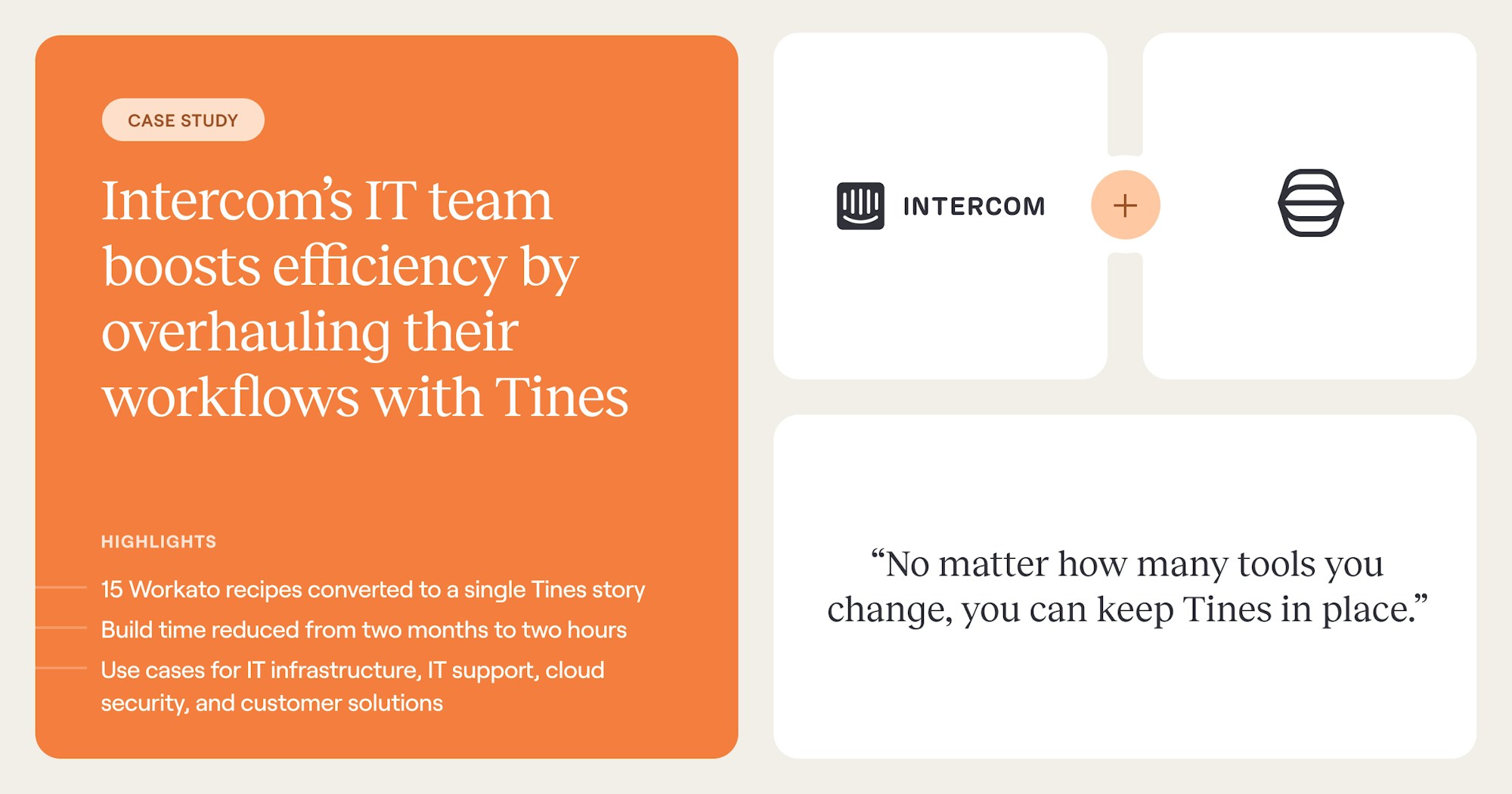
Intercom's IT team built a hardware-issue reporting workflow that lets employees scan a QR code on the device, opening a Tines Page that creates an Intercom conversation and routes the issue to automated remediation.
7. Workforce-wide security policy rollout
MFA enforcement, acceptable use policy acknowledgment, and security awareness training follow the same workflow automation pattern: distribute a requirement, track completion, escalate non-compliance, and produce audit evidence.
Enterprise MFA deployments follow a phased group rollout: IT and security teams first, then executives, then sensitive-data roles, then all employees and finally contractors. Teams can use a scheduled story in Tines to initiate each rollout phase, apply policies in Okta via HTTP Request Actions, distribute notifications via Send Slack Actions and Send Email Actions, and track acknowledgment status in Cases, with escalation rules for missed deadlines.
A US-based crowdfunding platform used this pattern to reach 100% MFA adoption company-wide in weeks, with SSO checks triggering Slack alerts, manager escalation, IT escalation, and automatic disabling of non-compliant MFA methods.
8. Emergency and safety notifications
The HRIS provides employee contact information and location data for emergency notification workflows. When an incident occurs, the workflow segments the affected population by location, role, or department attributes, sends multi-channel notifications, tracks acknowledgment, and escalates when recipients don't confirm receipt.
Teams can use a notification story in Tines that uses a Webhook Action to receive the incident trigger, a Transform Action to segment the affected population by HRIS location data, and parallel Send SMS Actions, Send Email Actions, and Send Slack Actions to deliver notifications simultaneously while Cases track acknowledgment.
McKesson's Active Defense team uses the same incident communication pattern across a 78,000-person workforce. Incident chat-room setup is fully automated with the correct invites and documents (replacing a manual process that previously pulled in up to 55 people), and suspicious-login verification emails go out immediately in the recipient's correct language rather than waiting for a human to draft a translation.
Where AI fits in HR workflows and where the category is heading
AI adds value in three specific areas: access recommendations based on peer-group analysis, anomaly detection in identity and HR data, and natural-language handling of employee requests. AI-driven identity governance can recommend access provisioning based on role, behavior, and peer-group patterns, shifting access management from reactive reviews to predictive provisioning.
GDPR requires that individuals can obtain human intervention and contest automated decisions, which sets a baseline expectation that employment-related AI decisions stay reviewable rather than running fully autonomously.
The IAPP's AI Governance Profession Report found that 77% of organizations are building AI governance programs, yet only 36% have adopted a formal framework such as the NIST AI RMF (AI Risk Management Framework). That gap between intent and formal framework is where most HR AI deployments sit today. In Forrester research commissioned by Tines, 88% of IT and security decision-makers said that without orchestration, AI remains fragmented, while 54% prioritize AI governance, privacy, and regulatory compliance.
When AI crosses departmental lines (operations, compliance, HR), governance comes down to decision rights: who reviews, who approves, who can explain the outcome to a regulator. Teams typically start with intake, routing, and recommendations, then keep humans in the approval path for sensitive decisions.
From there, agentic AI will move access management toward continuous, policy-driven provisioning, but only if governed orchestration is built in from the start. With the average enterprise already running 247 applications, the orchestration layer between HRIS and identity systems becomes the control plane for all workforce operations.
The orchestration layer is the architectural answer
HR workflow automation closes seams. The security exposure, the compliance risk, the day-one access failures, and the orphaned accounts that survive termination all live at the boundaries between systems.
The eight workflows in this article exist because identity, access, and operations data live in separate systems with no shared state, and the orchestration layer between those systems is the only architectural answer that scales.
That orchestration layer carries its own requirements: audit trails, approval logic, and AI guardrails need to be designed in rather than bolted on. The customer patterns referenced throughout this article (Vimeo's reconciliation, Brex's onboarding, Personio's offboarding, Notion's access requests, Intercom's hardware reporting, McKesson's incident communication) all combine deterministic provisioning, agentic AI for classification and recommendations, and human-in-the-loop approvals on the same surface.
Across Tines customers, 75% use the platform across multiple teams, which is what allows a single workflow to span the HR, IT, and security boundary in the first place. Want to see how this works in practice?
Book a demo to walk through HR workflow examples with the Tines team, or spin up a free Community Edition account.
Frequently asked questions about HR workflow automation
What's the difference between HR workflow automation and native HRIS automation?
Native HRIS automation handles processes within the HR system: document collection, task checklists and payroll triggers. HR workflow automation coordinates actions across systems in response to HR events. When a termination fires in Workday, native automation can update the HR record. HR workflow automation revokes access in Okta, deprovisions 20 SaaS applications, reclaims hardware, and produces the audit trail.
How fast does access revocation need to happen after termination?
CISA's January 2025 final rule sets "promptly revoke credentials upon termination or role change" as the standard, and official materials indicate revocation should occur within 10 days after the triggering event. NIST SP 800-171r2 recommends disabling system access within an organization-defined time period when employment is terminated. Event-driven HRIS-to-IAM integration helps teams meet those requirements.
How do we handle SaaS applications that aren't connected to our identity provider?
SCIM support varies widely across enterprise application portfolios. Where applications are not SCIM-connected, organizations often rely on compensating controls such as direct API provisioning where available, human-task routing where it isn't, and reconciliation workflows that compare actual access state against expected policy state. Manual offboarding checklists remain a required backstop for applications that fall entirely outside the scope of automated coverage.
Can AI make autonomous access decisions in HR workflows?
The EU AI Act classifies employment-related AI as high-risk and requires human oversight. GDPR gives individuals the right to contest automated decisions. The governed pattern is AI for recommendation and enrichment, human review for sensitive decisions, and deterministic execution for the provisioning or revocation that follows.
How does agentic AI change HR workflow automation?
Agentic AI moves access management toward continuous, policy-driven provisioning, where AI agents evaluate context (role, peer entitlements, anomalous behavior) and propose or execute access changes inside guardrails set by the orchestration layer. In HR-adjacent workflows, that typically looks like an agent drafting an access recommendation from the joiner event, a human approver confirming for sensitive scopes, and the platform executing the provisioning deterministically. Without a governed orchestration layer underneath, agentic AI in HR fragments across tools and breaks the audit trail that EU AI Act and GDPR review depends on.
What do People, IT, and security teams gain from building HR workflows on the same orchestration platform?
A shared platform collapses the handoffs that cause day-one access failures and offboarding gaps: HR's joiner event, IT's provisioning, and security's access verification run as a single workflow with a single audit trail. It also lets each team contribute the workflows they own without rebuilding integrations, which is why teams like Notion's SecOps and IT functions ship Stories together on a single surface rather than maintaining parallel automation stacks.