
An employee gives notice on a Friday afternoon. By Monday morning, their Okta account is disabled, their laptop is in transit back to IT, and the offboarding ticket is marked complete. Three weeks later, a security review surfaces an active GitHub personal access token, an OAuth grant connecting a personal automation tool to company data, and an AWS IAM user still issuing API calls, all tied to the same departed employee.
The gap is a familiar one. Most teams treat the identity provider as the master switch, assuming that disabling an account in Okta or Entra ID will cascade to everything else. In modern environments, it doesn't. System for Cross-domain Identity Management (SCIM) covers only a fraction of the SaaS footprint; personal access tokens and OAuth grants live outside the IdP's visibility, and IT and security operate from separate checklists with separate triggers.
Closing those gaps is what employee offboarding automation is built for. This article walks through what offboarding automation looks like in practice, how to build it, and where it pays off. We'll cover where manual processes break down, the core components of an intelligent workflow, common mistakes to avoid, and how it fits into a broader IT and security operating model.
What is employee offboarding automation?
Employee offboarding automation is the programmatic revocation of a departing employee's access, recovery of their assets, and generation of compliance-ready audit trails, triggered by a single HRIS event.
But it has evolved well beyond scripts on a schedule into what's now called an intelligent workflow: automation plus orchestration, governance, and human-in-the-loop control. In other words, "automation" is the umbrella category most teams are searching for, and "intelligent workflow" is the more sophisticated shape that category takes in modern IT and security operations.
An intelligent workflow platform (IWP) delivers this through three connected layers:
Interaction layer: where people, AI agents, and copilots engage with workflows through chat, Slack, or pages.
Automation layer: which orchestrates the underlying actions across identity providers, SaaS apps, MDM systems, and infrastructure APIs.
Control layer: which wraps both with governance, approvals, audit logging, and policy enforcement.
For offboarding, that layered model turns a single HRIS event into a coordinated response. A manager approves a knowledge transfer in Slack or a security lead signs off on a privileged credential rotation (interaction). Parallel API calls fire to Okta, GitHub, AWS, and Google Workspace the moment an employee is marked as departing, closing the gap between last day and full deactivation, where insider risk accumulates (automation). And every action, approver, and timestamp lands in a single audit record that both IT and security can defend during a review (control).
Manual checklists and point scripts can replicate pieces of any one layer, but they can't hold all three together. That's why access lingers after an employee's last day, and why the gaps described above keep reappearing. Orchestrated identity and access management workflows close those gaps by integrating directly with identity and HR systems, so revocation happens on the trigger rather than at the end of a handoff chain.
The stages of manual employee offboarding, and where they break
Every manual offboarding process follows roughly the same sequence, and each stage has a predictable failure mode. The failures compound because each stage depends on the previous one completing correctly and on time.
Notification and trigger: The process starts when HR marks an employee as departing in the Human Resource Information System (HRIS), which generates an email or Slack message to IT. If that notification is delayed, routed incorrectly, or buried in a queue, the downstream revocation sequence starts late, and for involuntary terminations, even a few hours of delay creates an exploitable window.
Access revocation across identity, SaaS, and infrastructure: Disabling an account in Okta or Microsoft Entra ID propagates deprovisioning to SCIM-connected SaaS applications, but it doesn't cover the full SaaS footprint. Locally managed AWS IAM Users, GitHub personal access tokens, Jira API keys, and third-party OAuth grants can all remain valid after IdP deactivation, and even Entra ID session revocation doesn't immediately invalidate existing access tokens.
Asset and credential recovery: IT's device recovery workflow covers collection, wipe, and reissue, but remote recovery isn't always immediate, and without Mobile Device Management (MDM)-enforced locking, a device may remain accessible until the workflow completes. IT's standard wipe sequence can also remove information that security wants to review first, which makes the sequencing between lock, review, and wipe important.
Knowledge transfer and account ownership: Files, repositories, shared accounts, and billing contacts must be reassigned before the departing employee's account is deleted. The critical ordering dependency is that ownership transfer must happen before access revocation; you lose data or create an ownership vacuum that takes weeks to untangle.
Compliance documentation and audit trail: Manual offboarding produces partial, inconsistent logs, and no single audit trail can reconstruct whether access was fully revoked before or after a suspected incident.
Each of these failure modes is amplified by a structural problem: offboarding is a cross-domain process that most organizations run as parallel, disconnected tasks. HR fires the trigger, IT handles identity and devices, and security handles credential rotation, monitoring, and forensic review.
The space between those handoffs is the exploitable window, and during an audit or incident investigation, no single team owns the complete picture.
Why IT and security need to operate from the same offboarding workflow
Closing that gap requires shared triggers and a unified audit trail. A single HRIS status change should simultaneously trigger parallel workflows across IT and security, rather than a sequential chain in which one team finishes and hands off to the other.
Both teams should write to and read from the same audit record with consistent timestamps, because the forensically critical question, "was access fully revoked before or after the suspected breach?", can only be answered from a unified log. Across Tines customers, 75% use Tines across multiple teams, which is what makes that shared surface possible in the first place.
That model is not theoretical. At Brex, security and IT teams now analyze and suppress up to 90% of weekly alerts and automatically run identity onboarding that previously required 5 a.m. manual steps.
The offboarding lesson is the same: once both teams work on the same platform with the same triggers and records, timing gaps stop being someone else's problem and become part of a single workflow design. That workflow design starts with defining the core components of a unified intelligent workflow.
What are the core components of an automated offboarding workflow
An automated offboarding workflow has five core components, each tied to a failure mode from the manual process. Each component runs programmatically in response to a single HRIS trigger, while an intelligent workflow platform coordinates the sequence across teams and tools. The sections below break down what each component does and why it matters.
1. Identity and access governance
Intelligent workflows fire on the HRIS status change and execute IdP deactivation, SCIM propagation to connected applications, and HTTP Request Actions to each non-SCIM system's API in parallel. For shared credentials and secrets, the workflow triggers rotation rather than revocation alone. An explicit OAuth grant audit against the IdP's connected apps registry detects grants that persist after account deactivation.
2. Compliance, documentation, and audit trail
The workflow generates timestamped evidence as a byproduct of execution rather than as a separate documentation task. Every action generates a log entry attached to a single audit record: the HRIS trigger timestamp, each system's API response, the identity of the approver for any human-in-the-loop steps, and a final attestation. This record can help centralize offboarding documentation across multiple compliance frameworks, such as SOC 2, ISO 27001, HIPAA, and PCI DSS.
3. Equipment and asset recovery
MDM platforms (Microsoft Intune, Jamf Pro) provide API-accessible device actions. An intelligent workflow immediately fires a remote lock upon trigger. This gives teams time to complete any needed review before IT authorizes the full wipe. The workflow queues a wipe command for offline devices and executes it when the device reconnects.
4. Knowledge transfer and account ownership
Generally, teams may wait 2 weeks before deleting the account. The recommended pattern is to reset the password and disable recovery methods, while keeping the account active until administrators complete resource transfers and revoke OAuth grants.
The recommended pattern is to reset the password and disable recovery methods, while keeping the account active until administrators complete resource transfers and revoke OAuth grants.
5. Approvals and human-in-the-loop steps
Conditional logic routes involuntary terminations to immediate deactivation and standard resignations to end-of-day or delayed sequences, without depending on a human to decide the timing. Approval gates route to managers and security leads via Slack for steps that require judgment: security review before wipe authorization, privileged credential rotation affecting production systems, and final sign-off on knowledge transfer completion.
The point of this component is consolidation. Employee lifecycle work rarely fails on a single step. It fails when too many small workflows, tools, and approval paths have to line up at once, and when approval gates live inside one team's tool while the trigger lives in another's; those are exactly where offboarding stalls.
Routing all of them through a single story (Tines' term for a workflow) keeps the conditional logic, approver identities, and audit entries in the same place as the rest of the workflow.
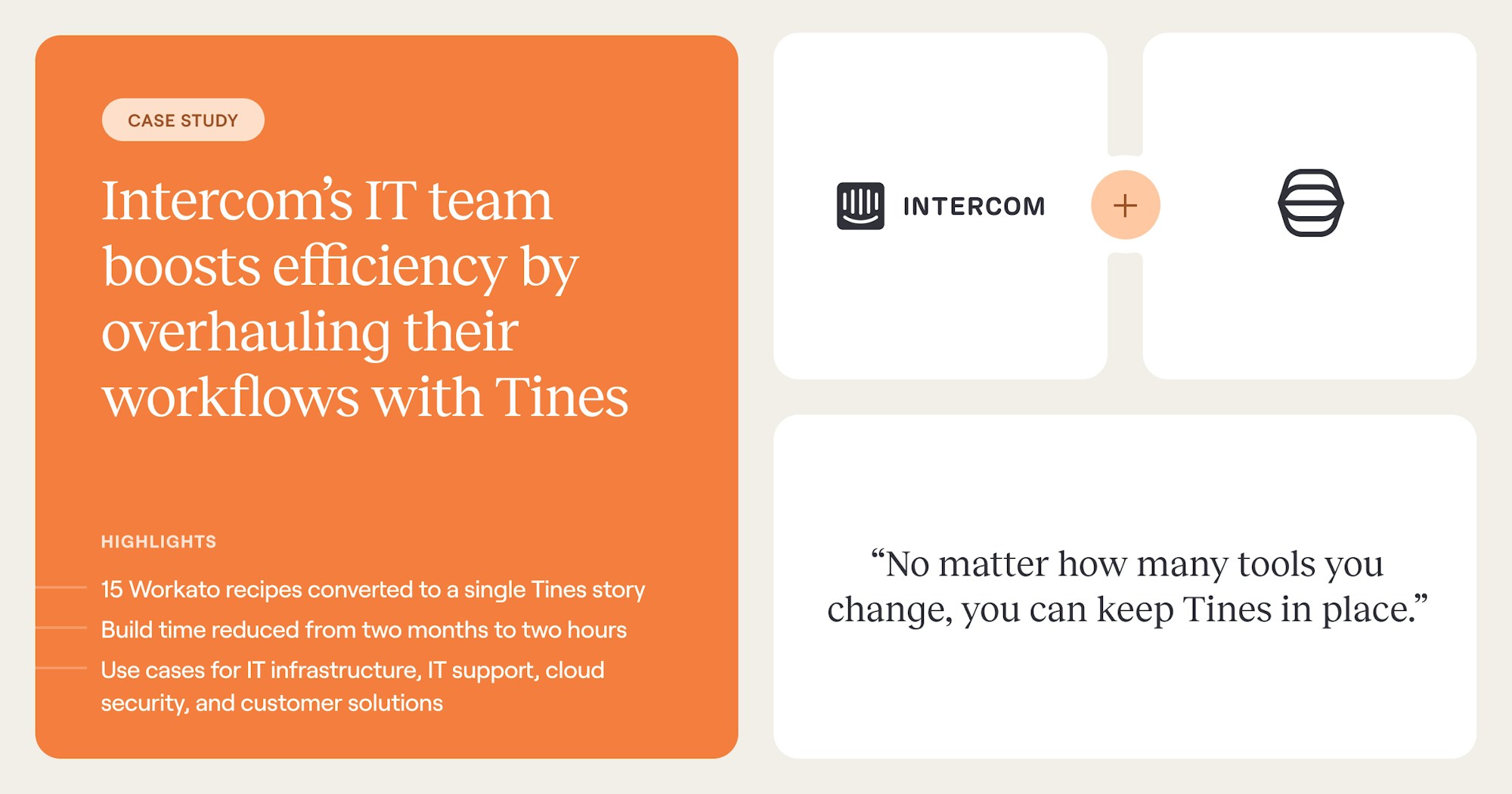
This consolidation pattern is clear in production. At Intercom, the IT team consolidated 15 separate workflows into a single Tines story and reduced build time from 2 months to 2 hours, with employee lifecycle automation including a Workday-to-Okta provisioning story built end-to-end in a week.
The takeaway is straightforward: one trigger, parallel execution, and a single audit record that both IT and security can read from.
Common offboarding mistakes and how to avoid them
Even teams that have invested in automation tend to repeat the same handful of mistakes, usually because they assume a single tool or trigger is doing more work than it actually is. The four below show up consistently:
Treating identity provider deactivation as complete offboarding: Disabling Okta automatically deprovisions apps connected via SCIM, but not SSO-only apps. Applications accessed via direct credentials, non-SSO-connected tools, and employee-provisioned shadow IT remain active indefinitely. An intelligent workflow must include explicit steps for non-SCIM applications and an OAuth grant audit against the IdP's connected apps registry.
Missing OAuth grants made by the employee themselves: Grants an employee created (connecting Slack to a personal Zapier account, authorizing a third-party app to access company Google Drive data) exist outside identity provider visibility and are not revoked when the IdP account is disabled. The fix is to run the OAuth grant audit as a deliberate step in the workflow.
Letting contractor and non-employee offboarding fall through the cracks: Contractors are often not entered into the HRIS, so the HRIS-triggered workflow never fires. A parallel trigger mechanism, such as a scheduled access review that flags accounts without a corresponding active HRIS record, closes that gap.
Maintaining full access through the entire notice period: This increases risk, especially for employees with access to sensitive systems or data. Intelligent workflows encode incremental privilege reduction during the notice period as conditional logic.
Fixing each of these mistakes individually helps, but the bigger payoff comes from rethinking where offboarding automation sits in your overall security and IT operations.
Where offboarding automation fits in the bigger picture
The real issue offboarding automation solves is that offboarding is a cross-domain process executed by teams with no shared workflow surface. HR, IT, and security each own a piece, operate on different timelines, use different tools, and produce different logs.
Automation that makes each team's silo faster doesn't fix the coordination failure. An intelligent workflow that connects those teams through shared triggers, audit trails, and visibility eliminates handoff gaps where risk lives. As SaaS sprawl accelerates and non-human identities multiply, the coordination gap between IT and security will widen unless teams invest in shared workflow surfaces now.
Through Tines, teams build intelligent offboarding workflows that span identity providers, SaaS applications, MDM platforms, and ticketing systems from a single surface. In those Stories, teams fire on an HRIS Webhook trigger and execute HTTP Request Actions to Okta, Google Workspace, GitHub, AWS, and Jira in parallel.
Approval gates route to managers and security leads via Slack, and every action is documented automatically. Teams can also start from pre-built templates in Tines' story Library, which covers common offboarding patterns across Active Directory, Entra ID, Okta, and Google Workspace.
Teams that have shipped offboarding automation in production share a common thread. They stopped treating offboarding as a checklist owned by one team and started treating it as a workflow that connects all the teams involved.
To see what that looks like for your stack, book a demo with our team.
Frequently asked questions about employee offboarding automation
What does identity provider deactivation miss during offboarding?
Disabling an account in Okta or Entra ID only propagates to SCIM-connected applications. Non-SSO SaaS tools, personal access tokens, AWS IAM API keys, OAuth grants to third-party apps, and shared credentials may remain active unless they are separately discovered and revoked during offboarding.
How should contractor and non-employee offboarding differ from employee offboarding?
Contractors often aren't in the HRIS, so the HRIS-triggered workflow never fires. A parallel trigger mechanism, typically a scheduled access review flagging accounts without corresponding active HRIS records, addresses this gap. Expiration dates on contractor accounts provide a secondary safeguard.
What is the recommended sequence for offboarding steps?
The critical ordering dependency is ownership transfer before access revocation. The recommended pattern starts with the HRIS webhook trigger, then reassigns files, repositories, and account ownership to the departing employee's manager. Only after transfers are complete should the workflow revoke access across IdP, SCIM, and non-SCIM applications in parallel. A compliance attestation, with timestamped evidence from each preceding step, closes the workflow.