
About Omada Health
Omada Health is a virtual care company founded in 2011 that helps millions of Americans manage chronic conditions like prediabetes, diabetes, hypertension, and musculoskeletal pain. Their clinically-validated programs combine human coaches with app-based technology, partnering with employers and health plans to deliver essential care between doctor visits.
Executive summary
Omada Health needed a solution that empowered employees across departments to build and orchestrate their own processes. Their previous platform required intense coding,which ultimately limited scalability and team-wide adoption. By implementing Tines, Omada democratized workflow creation across IT, security, and beyond, saving hours equal to the manual work of 3.5 full-time employees each month. Tines’ flexibility, templates, and self-hosting capabilities gave them the control needed for healthcare compliance while enabling rapid and secure adoption of AI and automation.
The challenge
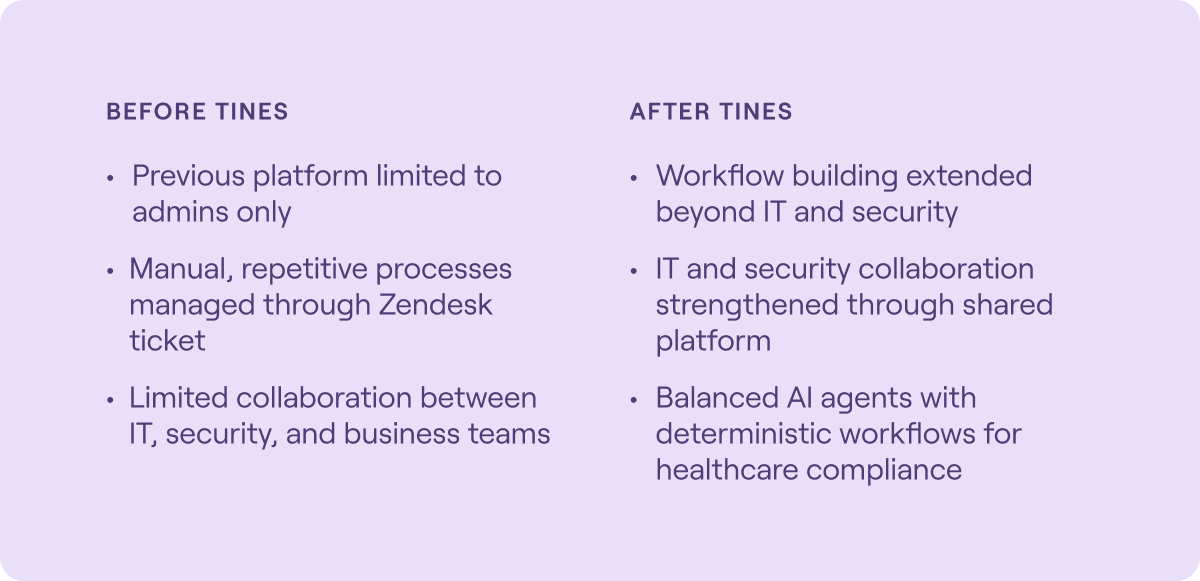
As Omada started growing as a company, they realized they needed a workflow platform that would scale with them. The capabilities of their previous solution only allowed admins to build workflows, severely limiting the scope of what the team could create. “It was not in a state where we could easily allow other people outside of security or IT to build things” said Senior Director of Information Security Greg Sonier. Based on the limitations encountered with their former vendor, Greg wanted his team to create and manage their own intelligent workflows, believing this would maximize the value each team member would get on an individual level.
The Omada team figured the best way to get familiar with Tines would be by building smaller workflows before rolling out longer initiatives. By taking this approach, Jeremy Gray, Senior Manager of IT Infrastructure noted it would be a “good way for us to incorporate AI without getting caught up in the hype of AI.” In a regulated industry like healthcare, the team is always mindful of how they introduce AI and how it interacts with their systems and data.
Why Tines
CISO Bill Dougherty’s vision was a world where the value of workflows was extended beyond IT and security, and he knew Tines was the platform that would achieve this. “[With Tines] I knew I could bring in something as an infosec tool and eventually use it for other use cases, versus going out and getting a general-purpose automation tool,” he said. Tines’ comprehensive template library enabled the team to truly build beyond IT and security, supporting all tools in Omada Health's stack. In assessing other products, Bill often found himself saying, “that’s a Tines story. Your product is my workflow.” Tines has enabled the team to avoid tool sprawl by allowing them to create the workflow themselves.
As a remote-first organization, Omada requires the right solutions to foster collaboration across teams, while maintaining mandated control across systems. This control over data and additional privacy is important in an industry like healthcare, which is why Omada chose to self-host their Tines tenants. Omada must be mindful of its member data and how its agents and automations interact with that information. “Pretty immediately, we found a really good balance, a good flexibility in how we could incorporate AI or not as appropriate to the workflow. We really appreciated that,” explained Jeremy.
The Impact
Since implementing Tines, Omada has built 33+ workflows that save over 600 hours monthly—and the impact continues to grow as more teams adopt the platform.
Tines is one of the best bets I’ve placed on a vendor in the last couple of years... It connects to all of our SaaS products, where we are going to be connecting it to our own core internal products. If you can dream the workflow, we can probably automate it.
Bill Dougherty, Omada Health CISO
Cross-team collaboration
Bill has noticed IT and security working more closely together than they have in the past. He notes how “[Tines] has allowed us to bring in other groups and really build up some trust with [them].” Last year, Omada recorded 33 workflows that saved them 345 hours per month of manual effort. Across all departments, the team confirmed that was at least 600 hours a month of effort saved. And it’s just going up from there.
“It’s been the platform and the success on the platform [that has] enabled us to build up a lot more cross-functional work, which is really important for us.”
Simplicity in building
The IT team built a workflow for another team that processes a CSV file and sends that information to another team at Omada. A simple workflow to replace a simple yet tedious process. Jeremy was told by the requesting team that the new workflow was going to result in an 80-85% reduction in time spent, saving the team 180 hours a year.
Omada values the ease of understanding a workflow. Not relying strictly on code has given the team the freedom to inherit, extend, or troubleshoot a story with ease. “The product is friendly to people who are not necessarily technical or don’t know how to code… The benefit of the tool is that it’s not just code,” says Jeremy. For his team, they have the option to get really creative and maintain granular control, but even non-technical people can take a Tines certification and acheive just as much.
The real business value for the team is the openness of Tines. “I don’t need to ask Tines to build me a connector between two services” Jeremy explains. “If it’s an API, I can do it. If it transforms data, I can do it. If it’s AI, I can do it. And that ability to confidently say ‘whatever your ask is, I can do something,’ that’s pretty bold.”
An intentional approach to AI
Omada takes an intentional approach to balancing agents and deterministic workflows. Depending on the workflow, should it have a single agent equipped with numerous instructions and tools, or multiple specialized agents to reduce the risk of unintended behavior?
The team had a meeting to determine how they could conceptualize AI agents across the company. “We said we can’t just have a monolith. We have to have modularity in AI” said Jeremy. “We’re trying to limit the blast radius of AI gone wrong. We have to be able to monitor and explain and send alerts, etc. And we really do get that ability fully in the way that Tines has implemented agents.”
Looking to Omada’s future with Tines, Greg is particularly excited to build AI agents using the JSON schema builder in the AI Agent action, believing that having that defined output structure will bring faster value from their agents.
Top workflows
Within the first few days of acquiring Tines, the IT team jumped right into a three-day hackathon, with groups coming up with 5 different workflows each. Some of those workflows went straight into production that very day. A number of these workflows remain their top-used stories today.
Attribute-based access control
Omada built a workflow that automates access provisioning based on employee attributes—role, department, and tenure—eliminating the need to manually process access requests through tickets. The system automatically grants appropriate permissions when employees join, change roles, or need access to new systems, fundamentally transforming how IT manages access across the organization.
Through this workflow, Jeremy and his team have noticed:
Reduced end-user friction with asks for role access lowering
Increased team capacity by not having to add and change requests all the time
Audit-ready documentation for IT general controls, reducing compliance risk and prep time
Phishing alert management
The security team sees a lot of phishing alerts come in via Zendesk tickets. This workflow allows them to send an email directly to Tines as an IMAP request and create a case based on the alert. At the same time, Tines performs analysis and provides feedback to the employee who reported the phishing incident, ultimately improving the security posture of the business
“It’s super cool because that’s not something we’re doing today,” says Greg. “Now Tines gives us the ability to send a notification back to an employee and confirm it’s phishing or not. It provides the employee a good sense that we do care about what they’re reporting.”
Ticket summarization
With a desire to use Tines across the business, the following story ultimately proved Bill correct: Tines was applicable across the board.
Human agents utilize Zendesk when speaking with clients on support calls. Omada built a story that connects to Zendesk and summarizes the five most recent tickets connected to a client, then posts it as a note for a human agent to access. In what used to have human agents scrambling for contextual client information, the employee has a well-written summarization of all the previous support cases involving that contact.
“We estimated last July that we were saving 167 man hours a month just with that story” said Bill. Imagine those numbers today!
Favorite features
Greg and Jeremy’s favorite features revolve around the speed and simplicity of Tines.
Managing a self-hosted tenant, Greg appreciates the speed at which Tines rolls out new features, “I like seeing that you are really pushing the envelope of [self-hosted] updates every other week.”
But Greg’s favorite feature? Templates. “I love the templates. I think those are super cool. Saves me a lot of time from having to go do research on an API.”
Tines enables the team to build quickly and appreciate the value of simplicity, with Jeremy’s favorite feature being the ease of making an API call with the cURL to Tines feature. “I love that if I go to any developer’s API docs, I can just copy/paste the block in and it makes the call. It just makes an API.” For Jeremy, this really helps reduce friction and provides endless possibilities for what he can build with any tool in the tech stack.
What’s next
Tines is fast becoming a primary piece of Omada Health’s tech stack, and there’s no slowing down what the team hopes to accomplish in the near future.
According to Bill, they’re in the process of forming a new team next year to do “nothing but process automation with Tines as the primary platform.” The goal is to create a team that’s focused on business process automation for other departments. By just focusing on what they can achieve with intelligent workflows, their goal is to reduce ticket handling time by at least 20% next year.
Other potential projects include combining AI and automation that will help the recruitment team, legal and compliance, reviews for marketing assets, and more. The work doesn’t stop at just IT and security, it spans across the organization, with Tines at the helm.