
About the customer
Vimeo is a global video creation and collaboration platform. Their security and IT organizations ensure internal access and activity remain visible and aligned, which supports both workforce safety and operational trust. They manage identity lifecycles, incident routing, provisioning, and vulnerability review across dozens of tools that change frequently.
Executive summary
Vimeo uses Tines to consolidate identity checks, vulnerability intake, and incident response into a single shared operating environment accessible to both security and IT. What once required manual reviews, exports, and ticket cleanup now runs automatically with clear ownership.
Offboarding discrepancies surface before they reach audit cycles, vulnerability tickets arrive ready to be addressed, and incident response follows a single defined path from alert to action. Tines is the common foundation across Vimeo’s security and IT teams, so work remains distinct where it should be, but understood and coordinated in the same system.
The challenge
Before Tines, Vimeo’s security and IT processes operated in parallel but rarely in the same space. About 30 applications needed to connect into their access management platform, Lumos, but very few had native integrations. Lifecycle checks were handled manually. IT maintained identity logic in Okta, but had difficulty connecting to all the systems that needed to feed into it. Vulnerability alerts flowed in, but did not enter Jira cleanly. Incident activity showed up across different sources with no single place to triage or act on.
The work was getting done, but it was spread across tools and formats. By the time quarterly audits arrived, the teams already knew their manual comparison and export cycles were not built for daily change. The issue wasn't people or process, it was tool fragmentation. Security and IT were solving many of the same problems but doing so in different systems, in various ways.
Why Tines
When Vimeo evaluated Retool, Tray.io, Okta Workflows, and Tines, the result was not a debate about features. It came down to clarity and momentum.
Connor Murphy, Senior IAM Manager at Vimeo, shared, “I knew right away in Tines what type of information I was sending, who I was sending it to, and how to copy, reuse, and troubleshoot it. Okta Workflows gave us a starting point, but Tines gave us visibility and the ability to easily re-use components of the workflow. Tray.io lacked the transparency we needed, and Retool required extensive development time. But in Tines, everything felt easy and approachable, enabling me to ramp faster.”
Tines became more than a way to automate tasks. It became the place where they could see their workflow logic clearly and understand what was happening at each step. Connor noted, “I couldn't connect every technology I use as easily without Tines, period. The audit trail that Tines provides is incredible.”
Connor also appreciates the future-focused strategic enablement Tines provides, sharing “Tines is for all the things that have been asked of me and those that haven’t yet been asked. It lets me build what I need to now, while helping me anticipate and prepare for future asks.” What’s more, Vimeo’s security and IT teams can now work from the same platform and speak the same operational language. While they build separately where needed, they can ideate and strategize together in Tines.
The Impact
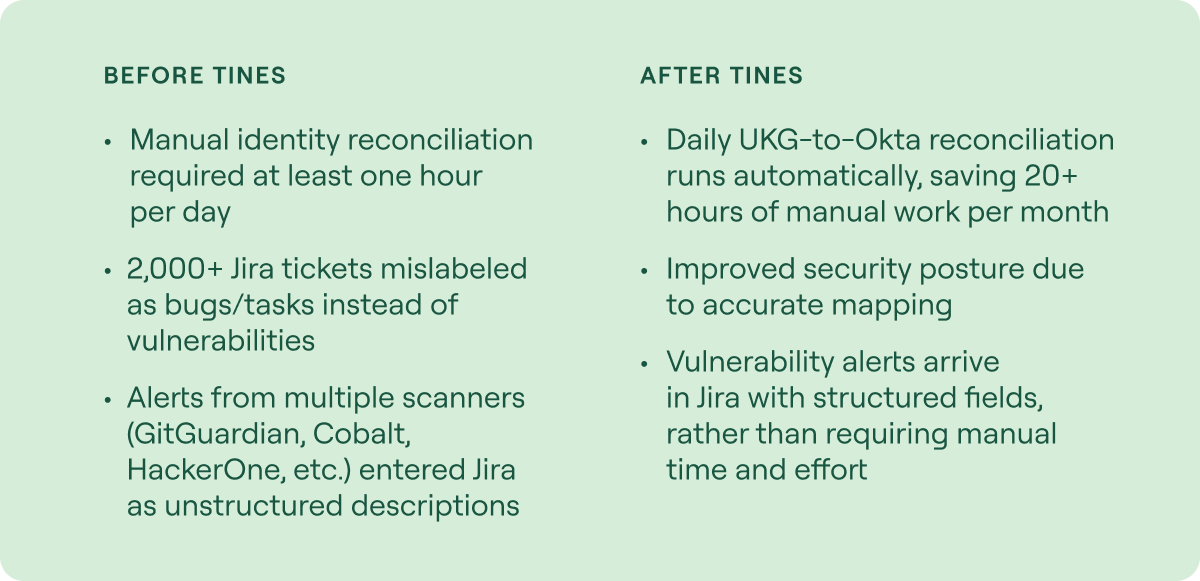
Tines brought visibility and orchestration to the work that used to require significant manual effort. Identity access mismatches show up right away, alerts are easily structured, and incidents follow a consistent triage path.
A daily identity safety net
The “UKG to Okta identity reconciliation” workflow now runs every morning. It checks every user in their human resource information system (UKG) against Okta and flags any inconsistent termination states. What once took at least an hour of manual work per day is now handled automatically without the need for spreadsheets or re-running reports. Instead of waiting for quarterly sampling to surface an access oversight, the team sees it within 24 hours. Connor described it as reclaiming time and confidence. Catching issues daily means they no longer wait for audit cycles to surface risks.
Vulnerability alerts that are structured and actionable
Their centralized vulnerability workflow changed how tickets are added to Jira. Instead of unstructured descriptions, Tines parses and maps every field from GitGuardian, Cobalt, and HackerOne before creating the ticket. Teams do not sift through or rewrite fields. Everything arrives ready to be assigned and worked on.
Converting 2,000+ historical Jira tickets without the lift
Vimeo also used Tines with Gemini AI to correct more than 2,000 historical Jira tickets that were incorrectly marked as bugs or tasks, but were actually vulnerabilities. Legacy integrations lumped all details into the description field, making mass conversion nearly impossible without manual parsing. With Tines formatting those records into the correct structure and fields, the team eliminated what had previously taken 20-40 minutes of manual triage per ticket, saving over a thousand hours of backlog cleanup and counting.
Justin Bacco, Principal Application Security Engineer at Vimeo, explained that this kind of work often stalls not because it lacks value, but because the effort required feels unrealistic. As he put it, “What makes Tines valuable is how quick and simple it is to build intricate systems. If you want to build something unorthodox and time-intensive, you’ll often get pushback: ‘We don’t have time to prioritize that — let’s just keep doing it the old way.’ But if you can reduce a project’s development timeline from several months to a few weeks, you’ll suddenly find people are much more open-minded.” In Vimeo’s case, the vulnerability ticket conversion was exactly that kind of project — “a shining example of a cutting-edge idea that might never have come to fruition otherwise.”
Incident response that feels like one motion
Connor and the team built a new incident response model using Tines, AI agents, FireHydrant, and Slack. Instead of alerts living across separate tools, everything now follows a single workflow. The agents they built in Tines read internal documentation and owners, and provide context so responders know who to involve and why. When alerts arrive outside business hours, the team does not spend time searching systems for context. Tines surfaces what responders need so they don’t have to manually find it.
A platform that inspires use rather than forces it
The most meaningful outcome was not any one workflow; it was how much Connor found himself wanting to keep building in Tines. Connor said he spends every day in Tines and continues to find room for new ideas. Some workflows solve immediate gaps. Others simply show what could come next.
Top workflows
Identity reconciliation
This workflow runs each morning to compare every active worker in UKG against every account in Okta, automatically identifying mismatches. Instead of identity hygiene happening only during audit windows, it is now part of the team’s daily motion. As Connor put it, “I see mismatches the day they happen,” which means the team can address access issues in a timely manner before audit cycles rather than discovering them during later review periods.
Vulnerability management and ticket creation
Instead of alerts arriving individually and in different formats, Tines ingests findings from tools (like GitGuardian, Cobalt, HackerOne) and then writes clean Jira tickets with defined fields, labels, and ownership. Tickets land ready to be worked on, starting at the remediation stage. This shift replaces what used to be weeks of manual cleanup and field correction with clean, usable intake the moment a vulnerability is reported.
Incident response
A security alert triggers a FireHydrant incident, opens a Slack channel, and enriches context through an AI agent by reading runbooks, ownership lists, and escalation paths. Connor noted, “If an alert comes in at one in the morning, we need to act fast. Tines gives us the context right away,” so responders know who to involve and why without tool switching. This created a singular response path instead of several, allowing the team to act without losing time to system coordination.
Lumos access data flows
More than 30 applications that do not integrate natively with Lumos now pass through Tines. Tines retrieves the necessary data and formats it so Lumos receives it in a normalized state. As Connor shared, “It feels like every tool with an API has a native Lumos integration, even when it doesn’t,” which means access data lands cleanly without engineering workarounds, custom connectors, or manual ingestion.
“If an alert comes in at one in the morning, we need to act fast. Tines gives us the context right away."
Connor Murphy, Sr. IAM Manager, Vimeo
Favorite feature
Connor uses Workbench constantly, not just when he needs help, but to inspire creativity and speed up his processes. He described troubleshooting through Workbench as “an under-appreciated feature” because he can ask what is happening and see it unfold step by step. He also has it create notes for him during builds so he does not have to document everything himself. Workbench is his spot to check what a workflow is doing, learn from it, and verify without slowing down.
Connor also mentioned the ability to copy and paste actions between flows is a game-changer for the team, noting “If I need to reuse something, I can just copy it and drop it where it belongs on the storyboard instead of starting over.” That simple capability accelerated onboarding at Vimeo and helped the team scale without fatigue.
Pages
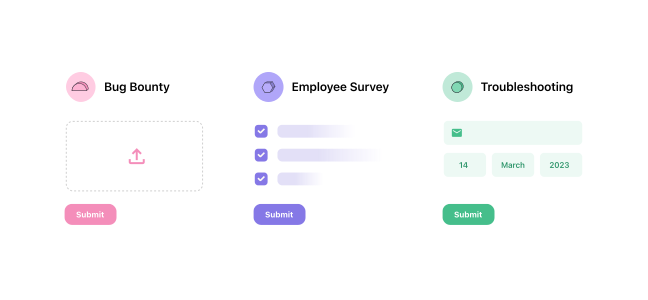
Interact with and share insights from the workflow through simple, elegant webpages.
What’s next
Vimeo is entering its next phase of intelligent workflow building with a clearer understanding of where AI agents, rule-based steps, and human review should sit within their processes. The current incident model is phase one. The next phases will likely expand to where rules-based logic can orchestrate actions, what should be paused for human review, and where AI can help interpret context before action is taken. On the IT side specifically, there is early exploration of using Tines to support internal help desk requests by referencing existing knowledge bases from Slack with the help of AI agents.
For the Connor and the Vimeo team, there are more ideas than hours in the day when it comes to Tines, but they continue to innovate with a steady progress that maintains visibility and control at every step. Connor shared, “If I could spend the day building in Tines, I would. I would do it for the rest of my career. There is always something more I can make.”